Why Adult Acne Loves the Jawline (And What's Actually Causing It)
Sound familiar: your skincare shelf is full of serious, well-researched products, your twenties are long behind you, and yet a cluster of deep, sore spots keeps showing up in exactly the same place, right along your jaw. At The Adare Dermatology Clinic, Chelsea, this is one of the most frequent concerns we hear from adult patients, and the location isn't random. It's a strong clinical clue.
Jaw-focused breakouts in adulthood are rarely the same condition as the acne many people had as teenagers. The mechanism is different, the triggers are different, and getting real improvement usually means treating the underlying cause rather than the spots themselves. Here's what's actually going on beneath the surface.
Recognising the Pattern
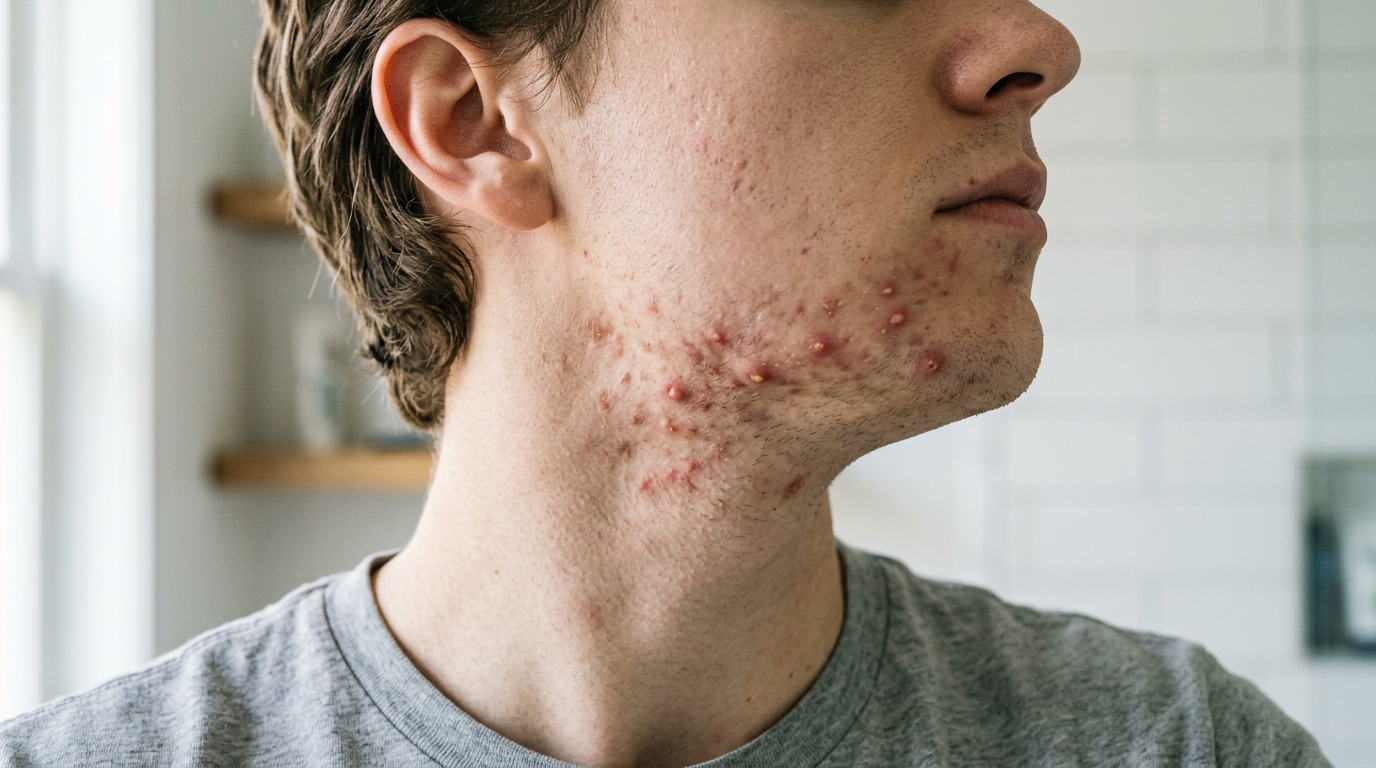
Hormonally driven acne has a fairly distinctive signature. It clusters along the lower face, jawline, chin, and sometimes the neck, rather than spreading across the forehead and cheeks the way teenage acne often does. The lesions themselves also tend to sit deeper in the skin: firm, tender nodules or cysts rather than surface-level whiteheads. And for many patients, there's a rhythm to it, with breakouts reliably appearing in the days leading up to a period.
If your acne story is "clear skin for years, then a shift toward jaw-only, cyclical, deep breakouts in your late twenties or beyond," that pattern alone tells us a great deal before we've even examined your skin.
The Underlying Mechanism: Androgens at Work
The driving force behind hormonal acne is a group of hormones called androgens, testosterone being the most familiar of them. Every sebaceous gland attached to a facial hair follicle carries androgen receptors, and when androgens bind to those receptors, two things happen: oil production ramps up, and the skin cells lining the follicle shed abnormally, clumping together rather than clearing away normally.
That combination, more oil and a partially obstructed follicle, creates exactly the environment Cutibacterium acnes (the bacterium formerly called Propionibacterium acnes) thrives in. It's present on everyone's skin, but under these conditions it multiplies quickly, and the resulting immune response is what produces the deep, inflamed, often painful lesions typical of hormonal acne, quite different from the more superficial breakouts of adolescence.
What's worth understanding is that this doesn't require abnormally high hormone levels. Blood tests in many hormonal acne patients come back entirely normal. What actually differs is local sensitivity: an enzyme called 5-alpha-reductase converts testosterone into the more potent dihydrotestosterone (DHT) directly within skin tissue, and this conversion appears to run more efficiently in acne-prone skin. The same hormone level, in other words, can produce a far stronger effect depending on the skin itself.
So Why the Jaw, Specifically?
This is one of the most common questions we field in clinic, and while dermatology is still refining a complete explanation, the working theory relates to receptor density. Androgen receptors and sebaceous glands aren't distributed evenly across the face, and the jawline, chin, and mandibular region seem to carry a higher concentration of androgen-responsive follicles than areas like the forehead. Notably, this is also the zone where androgen-driven facial hair growth is most pronounced, which supports the idea that this skin is simply wired to respond more strongly to hormonal signals.
What Sets It Off or Makes It Worse
A handful of factors commonly interact with this underlying sensitivity:
Cycle-related hormone shifts. Progesterone climbs and then falls sharply just before a period, and that drop appears to unmask the skin's response to androgens, explaining the classic premenstrual flare.
Polycystic ovary syndrome (PCOS). This is a frequently missed underlying cause of persistent jawline acne. Alongside breakouts, watch for irregular or absent periods, excess facial or body hair growth, thinning scalp hair, or unexplained weight changes. Where these overlap with jawline acne, we usually recommend hormonal bloodwork, testosterone, DHEAS, and an LH:FSH ratio, coordinated with your GP or an endocrinologist.
Stopping the contraceptive pill. Certain pills contain progestins with anti-androgenic effects that had been quietly keeping acne in check. Coming off them can reveal a hormonal sensitivity that was there all along.
Chronic stress. Elevated cortisol from ongoing stress can amplify androgen activity and oil production, adding fuel to an existing tendency.
Diet and insulin. Diets high in refined carbohydrates and sugar, and for some people, dairy, are linked to raised insulin and IGF-1 levels, both of which can heighten androgen signalling in the skin.
Treatment That Targets the Cause, Not Just the Spot
Because hormonal acne runs on a different mechanism than typical teenage breakouts, it tends to respond best to a combined approach that addresses hormonal drivers alongside topical care.

Topical actives still form the base layer of treatment: retinoids to correct abnormal skin shedding, azelaic acid for its calming, mildly anti-androgenic properties, and benzoyl peroxide to keep bacterial load in check. Introducing these gradually helps avoid unnecessary irritation.
Combined hormonal contraceptives, particularly formulations with anti-androgenic progestins, are among the most effective medical options for hormonally driven acne, working by lowering circulating free androgens.
Spironolactone, an anti-androgen medication, blocks androgen receptors directly in the skin and reduces oil production at the source. In our experience, it's one of the most consistently effective options for adult jawline acne and is generally well tolerated with appropriate monitoring.
Isotretinoin can be the right option for severe, cystic, or scarring acne that hasn't responded to other treatment, working across several of the underlying processes simultaneously, though it needs close medical supervision.
In-clinic treatments, including select chemical peels, can help refine texture and fade post-inflammatory marks, but they work best alongside treatment of the hormonal driver rather than instead of it.
Everyday Habits That Support Treatment
Lifestyle adjustments won't resolve significant hormonal acne on their own, but they do meaningfully support other treatment: leaning toward a lower-glycaemic way of eating, noting whether dairy seems to correlate with your own flares, protecting your sleep, and keeping stress in check where you can. It's also worth avoiding the temptation to pick at jawline breakouts. Because these lesions sit deeper in the skin, picking substantially raises the risk of scarring and lingering pigmentation.
Getting a Proper Diagnosis
The single most useful step for jaw-focused breakouts is an accurate diagnosis. This pattern can resemble other conditions, including perioral dermatitis or folliculitis, and treatment only works well once the true cause is identified rather than reaching for a generic acne routine. If your breakouts sit along the jaw, track with your cycle, or come with other signs of hormonal imbalance, it's worth having them properly assessed.
At The Adare Dermatology Clinic, Chelsea, our team takes a full hormonal and skin history, arranges bloodwork where it's relevant, and builds a treatment plan around your individual hormonal picture rather than a generic acne protocol. Book a consultation with us to get to the actual cause of your jawline breakouts, not just another product to try.