Erasing the Past: What to Expect from Q-Switched Nd:YAG Tattoo Removal | Adare Dermatology
Plenty of people love their tattoos for life, and that's genuinely wonderful. But at our UK clinics, we also see a steady stream of patients who regret a tattoo they once loved, and it's worth being honest with them from the very first consultation: it is far easier, faster and cheaper to get a tattoo than it is to remove one. Removal is a genuine medical procedure, not a quick undo button, and setting realistic expectations upfront is the kindest thing we can do before treatment even begins.
How Q-Switched Nd:YAG Laser Removal Actually Works
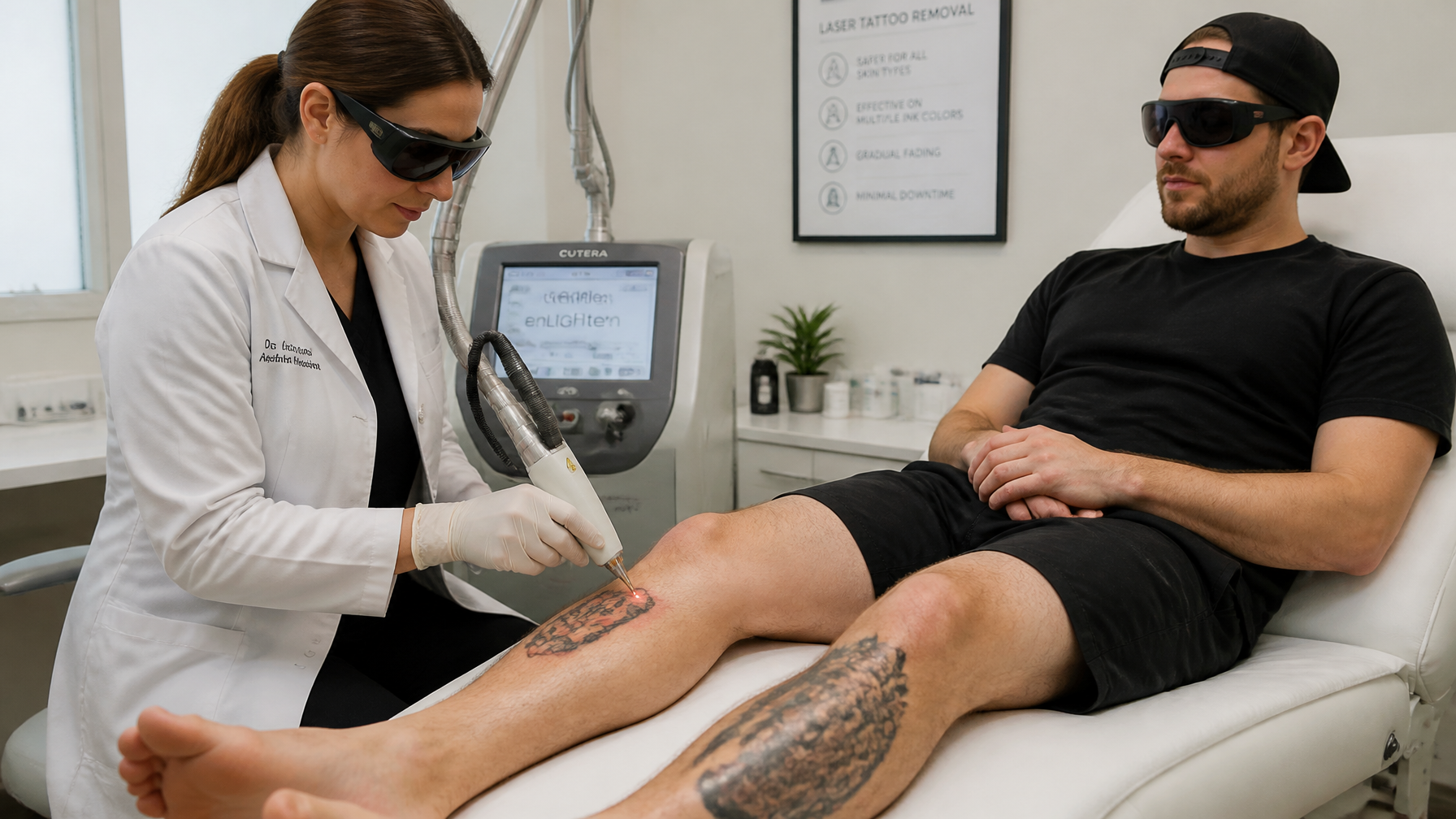
Q-switched Nd:YAG lasers remove tattoos by delivering extremely short, high-energy pulses of light that are selectively absorbed by the ink pigment sitting in the dermis, rather than by the surrounding skin. That energy is absorbed so rapidly that it creates a strong photoacoustic effect — essentially a tiny, controlled shockwave within the pigment particle itself. This is the mechanism behind everything that follows: the laser doesn't dissolve the ink chemically, it physically shatters it.
White Frosting: What You'll See During Treatment
Within moments of each laser pass, the treated skin typically turns a frosty white. This is called white frosting, and it's caused by the rapid heating and vaporisation of water within the tissue immediately surrounding the ink, forming tiny gas bubbles that scatter light and create that pale, frosted appearance. It's a genuinely useful visual marker for us during treatment, confirming the laser is reaching and interacting with the pigment as intended, and it typically settles within twenty to thirty minutes after the session ends.
Pigment Shattering and Multi-Session Immune Clearance

The photoacoustic shockwave from each pulse shatters the tattoo ink into much smaller fragments than the original particles. This matters because the body's immune system, specifically macrophages, can only clear away ink particles below a certain size; the original, larger ink particles used in tattooing are simply too big for the body to remove on its own, which is exactly why tattoos last indefinitely without treatment. Shattering the pigment into smaller fragments gives your immune system something it can actually work with, gradually engulfing and clearing those fragments away over the following weeks.
This is also precisely why tattoo removal always requires multiple sessions rather than one dramatic treatment. Each session only shatters the pigment further and allows a further round of immune clearance; the skin needs real time between sessions, typically six to eight weeks, for that clearance process to actually happen before it makes sense to treat again. Rushing sessions too close together doesn't speed up removal — it simply treats pigment fragments and tissue that haven't finished clearing from the last round.
Why Colour Makes Such a Difference
Different pigments absorb different wavelengths of laser light, which is why colour has such a significant impact on how easily a tattoo clears. Black ink absorbs across a broad range of wavelengths and is generally the most straightforward colour to treat. Reds and darker colours tend to respond reasonably well too. But certain colours, particularly yellows, light greens, light blues and whites, are genuinely difficult to remove and may respond poorly even after many sessions, because they simply don't absorb the available wavelengths as effectively. If you are anything less than completely certain about a multi-coloured tattoo, it's worth knowing this before you commit to the ink, not after — some colour combinations are considerably harder, slower and more expensive to remove than others.
Why Location, Age and Technique Affect Speed of Clearance
Several factors beyond colour genuinely affect how quickly a tattoo clears, and patients are often surprised by how much variation there can be. Areas with a rich blood supply, such as the face, clear considerably faster than areas with poorer circulation, such as the ankle, because immune clearance depends on that fragmented pigment actually being carried away by the bloodstream. Older tattoos tend to clear faster too, since the ink has often already begun breaking down naturally over years, giving treatment a head start. Non-professional, amateur tattoos also tend to clear faster than professionally applied ones, generally because the ink tends to be deposited less densely and less inconsistently than a trained tattoo artist would achieve, giving the laser and the immune system less work to do.
Large Tattoos: Why We Can't Treat Everything at Once

For a very large tattoo, such as a full back piece, we simply cannot treat the entire area in a single session. There are safe limits on how much treated surface area and total energy we can deliver in one sitting, both for comfort and for safety, so large tattoos are treated in sections over a longer overall course, rather than all at once. This adds to the total treatment timeline for bigger pieces, and it's something we plan for openly with patients from the very first consultation rather than something that comes as a surprise partway through.
Managing the Discomfort
It's only fair to say plainly that tattoo removal is a genuinely painful procedure — patients often describe the sensation as similar to, or more intense than, getting the original tattoo. We offer numbing cream to make sessions considerably more comfortable, and we'd encourage anyone considering removal to plan for this rather than being caught off guard by the intensity of the sensation on the day.
Setting Realistic Expectations
We get genuinely lovely results with Q-switched Nd:YAG removal, but it consistently takes longer than people expect going in. Multiple sessions, spaced weeks apart, over a period that often runs into many months or longer depending on the size, colour, age and location of the tattoo, is the realistic picture rather than the exception. Whether your goal is complete removal or simply lightening a tattoo enough to be covered by new artwork, we can help build a realistic plan and timeline around your specific tattoo and goals.
If you're considering tattoo removal, or lightening an existing tattoo ahead of a cover-up, book a consultation with one of our clinical specialists across our UK clinics. We'll give you an honest assessment of how many sessions your specific tattoo is likely to need, and what result you can realistically expect.