Article: What to Expect From a Hair Loss Consultation at Adare Dermatology Clinics
What to Expect From a Hair Loss Consultation at Adare Dermatology Clinics
Hair loss is one of the most emotionally difficult things a patient can bring into a consultation room, and yet it's often treated as an afterthought — a quick chat, a shampoo recommendation, and out the door. At Adare Dermatology Clinics (ADC), across our Dublin, Limerick and London clinics, we take a very different approach. Hair loss deserves the same thorough, structured assessment as any other complex medical condition, because the underlying causes are often far more nuanced than they first appear — and getting the diagnosis right from the outset changes everything about how successfully it can be treated.
Here's what patients can genuinely expect from a hair and scalp consultation with an experienced doctor or dermatologist at ADC.
A Detailed Medical History Comes First
Before anyone examines your scalp, we need to properly understand you as a patient. This isn't box-ticking — every question is there to help narrow down what's actually driving your hair loss.
Current medications. We ask about anything you're taking, because certain medications and hormonal changes are well-recognised triggers for hair shedding — telogen effluvium in particular can follow things like stopping the oral contraceptive pill, alongside a range of other alopecia types with medication-related triggers. Identifying this early can be the single biggest clue in the whole consultation.
Drug allergies. Knowing about any drug allergies is essential before we plan treatment, so we can avoid prescribing anything that risks an allergic reaction or a harmful drug interaction.
Medical and surgical history. We ask about any underlying disease and any surgeries you've had. Both can act as physiological triggers for telogen effluvium or certain alopecias, and surgical history also helps us gauge tolerability of local anaesthetics — relevant if procedures like scalp injections or hair transplantation become part of your future treatment plan.

Previous cosmetic procedures and satisfaction. If you've had cosmetic treatments before, we want to know how you felt about the results. There's little value in recommending a treatment you've already tried and found unhelpful, particularly if it was performed correctly the first time around — it simply tells us to look in a different direction. This part of the conversation also allows the doctor to sensitively screen for signs of body dysmorphic disorder, which is an important part of responsible cosmetic and dermatological care.
Family history. We'll ask whether your father, mother, or grandparents experienced hair loss. Family history is particularly relevant for androgenetic alopecia, alopecia areata, and frontal fibrosing alopecia, all of which have recognised hereditary patterns.
Other dermatological conditions, including in family members. This might seem like an unusual question, but associations between conditions can be genuinely diagnostic. For example, a family history of hidradenitis suppurativa in a parent can be relevant when a patient presents with dissecting cellulitis of the scalp — these conditions can share underlying mechanisms, and recognising the link can guide the diagnosis significantly.
Previous hair loss treatments. We ask what's already been tried, and how effective you felt it was. This tells us not only what hasn't worked, but also gives us insight into your preferences — whether you're more inclined towards topical treatments, oral medication, or surgical options going forward.
Understanding Your Current Hair Loss
Once we understand your broader medical background, we turn to the specifics of what's happening now.
-
When did it start? Establishing a clear starting point helps us understand the timeline and pace of the problem.
-
Where have you noticed hair loss or reduced density? This identifies the areas of greatest concern to you and helps guide exactly where the clinical examination should focus first.
-
Are your eyebrows or eyelashes affected? Any other body areas? Loss beyond the scalp can be an important diagnostic clue, pointing towards specific types of alopecia rather than others.
-
Have you noticed shedding, and since when? This helps us understand how concerning the shedding is to you personally, and also opens the door to questions about hair washing frequency, brushing habits, and whether tight hairstyles might be playing a role.
-
Have you had recent blood tests? Laboratory results — particularly ferritin levels and thyroid profile — can reveal underlying issues that are directly influencing your hair loss, and these are often things we'll want to check or repeat if they haven't been done recently.
The Physical Examination
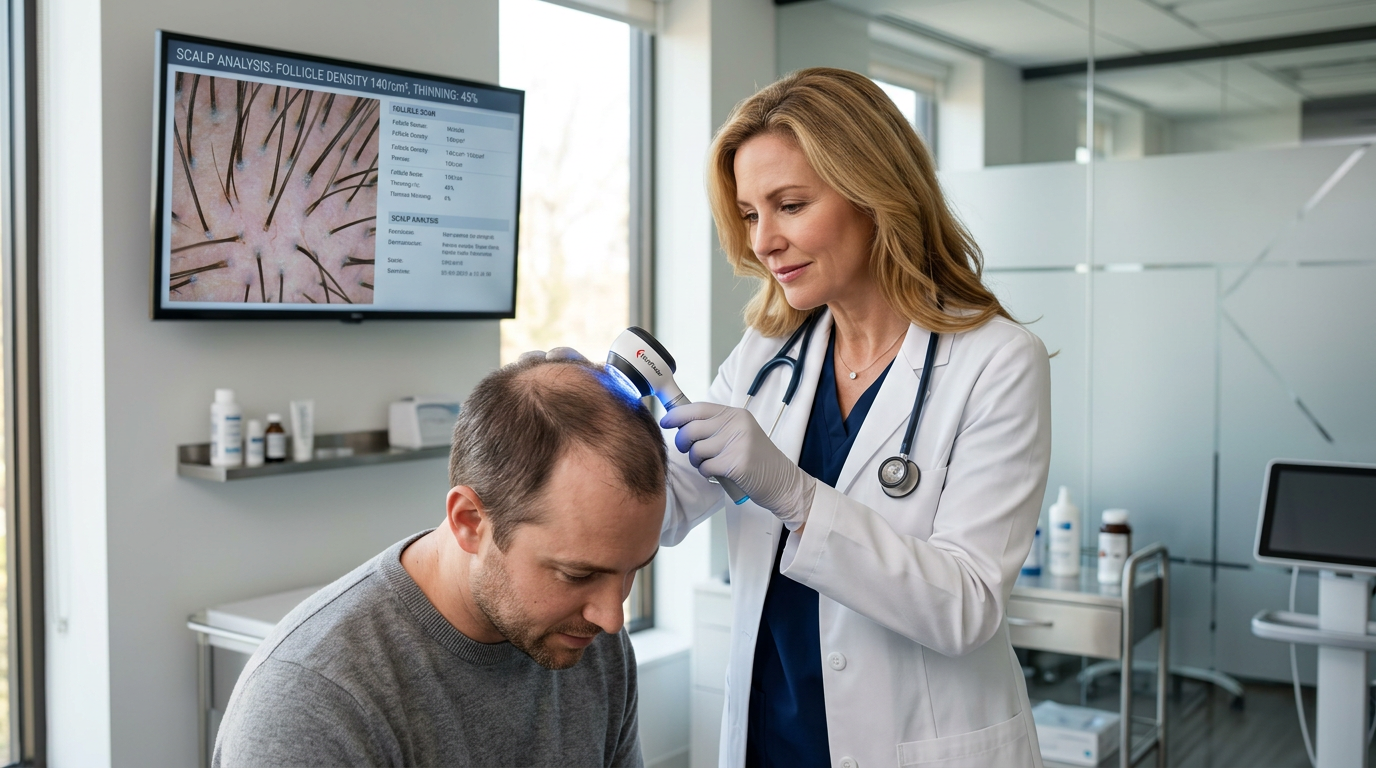
With the history complete, the doctor will carry out a thorough examination of the entire scalp surface using trichoscopy — dermoscopic examination that allows detailed assessment of hair density, the condition of individual follicles, and the hair shaft itself. This step is central to an accurate diagnosis and is far more informative than a visual assessment alone.
A hair pull test is often performed as part of this examination, giving useful information about active shedding at the time of your visit.
Occasionally, where the history raises particular concerns or the clinical picture is atypical, the doctor may recommend a diagnostic scalp biopsy. This is especially valuable for scarring alopecias such as lichen planopilaris, frontal fibrosing alopecia, and lupus-related hair loss, where a biopsy can confirm the diagnosis and guide exactly how aggressively treatment needs to proceed.
Developing Your Treatment Plan

Once the history and examination are complete — and biopsy results reviewed, where one has been taken — your doctor will discuss a tailored treatment plan with you. Depending on your diagnosis, this might include intradermal (intralesional) steroid injections for actively inflamed areas, dutasteride therapy, or other targeted medical treatments matched specifically to your type of hair loss and how far it has progressed.
Why This Level of Detail Matters
Hair loss is rarely a single, simple problem. Two patients with a receding hairline can have completely different underlying conditions — one hormonal, one autoimmune, one scarring and irreversible if left untreated, another entirely reversible with the right intervention. Skipping the detailed history, or skipping trichoscopy, risks missing that distinction entirely — and for scarring alopecias in particular, time lost to a missed or delayed diagnosis is time that can never be recovered.
This is why, at ADC, a hair and scalp consultation is never treated as a routine, rushed appointment. It's a dedicated, structured assessment designed to get the diagnosis right the first time, so that treatment can begin promptly and be genuinely matched to what's actually happening with your hair and scalp.
If you're concerned about hair thinning, shedding, or changes to your hairline, our specialist teams in Dublin, Limerick, or London are here to guide you through exactly this kind of thorough, evidence-based assessment — from that very first conversation through to a treatment plan built around you.