

The Sunscreen Blind Spots: Areas People Forget — and Why It's Costing Them
At Adare Dermatology Clinics (ADC), across our Dublin, Limerick, or London clinics, we are seeing an alarming and steady rise in skin cancer diagnoses — quite literally on a daily basis. Alongside this, we're seeing an explosion in hair loss consultations, many linked to rapid weight loss and GLP-1 medications. These two trends intersect in a way most people never consider: thinning hair means more exposed scalp, and more exposed scalp means more UV damage in an area almost nobody thinks to protect.
Sunscreen isn't just for the beach. It's daily, year-round protection for the areas of skin most consistently exposed to UV — and, unfortunately, most consistently missed. Here are the blind spots we see most often in clinic, and what we recommend.
The Ears: A Classic Miss
Ears are one of the most common sites we diagnose skin cancers on, and one of the easiest to explain why: creams are simply awkward to apply here. Women who tie their hair back for running or exercise expose their ears fully to UV with nothing on them. Men experiencing hair thinning lose the natural coverage their hair once provided, often without realising it. In both cases, a thick cream is fiddly, greasy, and easily forgotten around the ears and back of the neck.
This is exactly why we generally recommend a mist-format sunscreen for these areas. Our REFORM Skincare SPF 30 mist is lightweight, non-greasy, and genuinely easy to apply in seconds — which matters enormously, because the best sunscreen isn't the one with the highest number on the bottle, it's the one people actually use. For those wanting maximum protection, the REFORM SPF 50 mist offers a stronger block, though it is slightly less cosmetically light on the skin. Both are far better than the cream being left in the bathroom cabinet because it's a hassle on awkward areas.
The Scalp: An Increasingly Serious Problem
The scalp is becoming one of our biggest concerns in clinic — and not just for our long-standing bald or balding male patients. We are now seeing a significant rise in patients with thinning hair, often connected to the rapid weight loss associated with GLP-1 medications, leaving areas of exposed scalp that were previously covered.

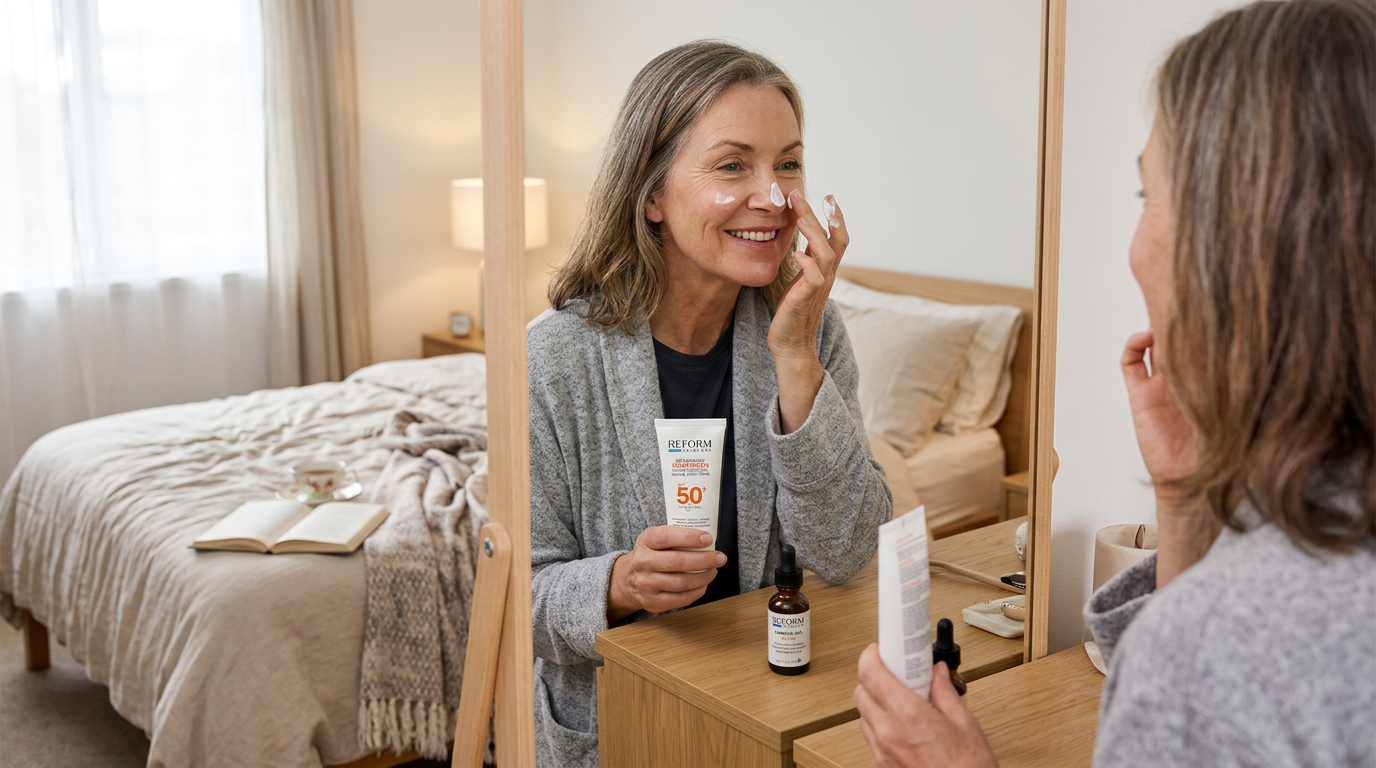
For patients who are completely bald, the REFORM Skincare SPF 50+ sunscreen cream provides excellent, robust protection against both UVB and the more insidious longer UVA wavelengths (critical wavelength 380nm) that penetrate deeply and silently. But for the much larger group of patients with thinning — rather than absent — hair, a cream on the scalp is often cosmetically unacceptable: it looks greasy, flattens the hair further, and is quickly abandoned. Here, the REFORM SPF 30 mist is our go-to recommendation. It gives genuinely good protection without the greasy look that kills compliance — and a sunscreen nobody wants to wear protects nobody.
This matters more than most people realise. A squamous cell carcinoma on the scalp or ear is not a minor cosmetic issue — it can metastasise to the lymph nodes and, left untreated, can be fatal. Scalp and ear protection deserves to be taken every bit as seriously as facial sunscreen.
Lips
Lips are another frequently forgotten area. The REFORM SPF 50+ sunscreen is very moisturising and can be used on the lips, though — like all sunscreen — it needs regular reapplication throughout the day. For patients who prefer a simpler routine, a dedicated SPF lip balm is also a popular and effective option.
Back of the Hands
The back of the hands is one of the most commonly missed areas of all, and one of the most visually striking when the damage is compared side to side. In clinic, we frequently show patients in the UK and Ireland a marked difference in age spots between their right and left hands — the result of years of driving, with UVA passing straight through the car window and causing accumulated daily damage on the driving-side hand, unprotected. Interestingly, this pattern reverses in the United States, where driving position is on the other side. Golfers show a similar effect: a striking contrast in sun damage between the gloved and ungloved hand.
Professional drivers — taxi drivers, ambulance drivers, and similar high-mileage occupations — are a particularly high-risk group in our clinics, commonly presenting with skin cancers on the nose, forehead, and driving-side hand. Many patients don't fully appreciate that while UVB is the sunburn-causing ray most associate with “the sun,” UVA is the silent, ever-present danger — it passes through glass, penetrates deeper into the skin, and causes cumulative damage every single day, sun visible or not.
Why People Skip Sunscreen — and How to Fix It
The single most common reason sunscreen is missed isn't lack of awareness. It's simply that people don't enjoy wearing it. This is especially true for teenagers managing acne-related scarring or hyperpigmentation, who are often reluctant to reapply a visible cream during the school or college day in front of their peers. For this group, a fine mist that doesn't clog pores, applied in under a second, dramatically improves compliance compared to a cream that has to be rubbed in.
Getting the right format of sunscreen for the right patient is just as important as the SPF number itself:
-
Mineral SPF 30 formulations are excellent under makeup and gentle on the eyes, but can be less cosmetically flattering on darker skin tones.
-
REFORM SPF 30 mist suits all skin tones, doesn't block pores, and is gentle around the eye area — making it a versatile daily option for most patients.
-
Skin type 1 patients — fair-skinned individuals with a naturally higher skin cancer risk, of whom there are a great many across the UK and Ireland, particularly as they age — need a robust SPF+ product worn daily on all exposed areas: face, neck, and backs of the hands.
Prevention Really Is Better Than Cure
We tell our patients honestly: if you damage your face, there is a great deal we can do to help restore it — Botox, dermal fillers, Sculptra, laser treatments — provided you have the means and inclination to invest in it. But if you damage the skin on your hands and neck, correcting that is far harder. Prevention is, without question, better than cure.
There's a further cosmetic bonus to a moisturising sunscreen like REFORM SPF 50+: on older, more sun-damaged skin, it helps skin look plumper and more youthful. A purely mineral sunscreen on very mature, wrinkled skin can sometimes accentuate texture rather than soften it — an effect patients understandably dislike, and one that, again, damages long-term compliance.

We'd also encourage pairing daily sunscreen with a vitamin C serum, which meaningfully boosts sunscreen efficacy, and a retinol at night (unless pregnant or breastfeeding) as part of a complete anti-ageing and skin-protection routine.
Some Sunscreen Is Always Better Than None
Finally, a reassurance we give often in clinic: SPF 30, and even SPF 15, are still genuinely effective sunscreens, provided they are properly tested and compliant with regulatory standards. They simply require more frequent reapplication throughout the day than a higher SPF product. The right message isn't “use the highest number or nothing” — it's use something, consistently, on every exposed area — including the ones you're most likely to forget.
If you're concerned about sun damage, unusual moles, or a lesion on the scalp, ears, or hands, the specialist team at Adare Dermatology Clinics in Dublin, Limerick, or London is here to help — and the REFORM Skincare range is designed to make consistent, effective protection genuinely easy to stick to.

,%20across%20our%20%0ADublin,%C2%A0Limerick,%20or%C2%A0London%20clinics,%20we%20are%20seeing%20an%20alarming%20and%20steady%20rise%20in%20skin%20cancer%20diagnoses%20%E2%80%94%20quite%20literally%20on%20a%20daily%20basis.%20Alongside...)