Medical Laser Tattoo Removal UK | Doctor-Led Clinic
Tattoos are designed to be permanent—ink particles are deposited deep into the dermis, where they become too large for the body's immune system to clear on its own. For the millions of people who experience tattoo regret each year, the promise of removal can feel urgent. But not all tattoo removal is created equal. The difference between a safe, effective outcome and one marred by scarring, burns, or incomplete fading often comes down to one critical factor: who is holding the laser, and what kind of laser they're using.
Medical-grade tattoo removal—performed by GMC-registered dermatologists or doctors using advanced picosecond and Nd:YAG laser systems—represents the gold standard in safe tattoo fading. Here is why it matters.
How Laser Tattoo Removal Actually Works
Laser tattoo removal relies on a principle called selective photothermolysis. Specific wavelengths of laser light are directed into the skin, where they are absorbed by tattoo ink particles. The rapid absorption of energy causes the ink particles to shatter into fragments small enough for the body's macrophages—immune cells—to engulf and carry away through the lymphatic system.
The key variables that determine success are:
-
The wavelength of the laser: Which must match the specific colour of the ink.
-
The pulse duration: How quickly the energy is delivered.
-
The energy density (fluence): The strength of the laser beam.
Get any of these wrong, and you risk either failing to break apart the ink or causing severe damage to the surrounding skin tissue. This is where the technology—and the medical expertise behind it—becomes decisive.
Laser Technologies: The Tools of the Trade
Nd:YAG Lasers: The Proven Workhorse
The Q-switched Nd:YAG (neodymium-doped yttrium aluminium garnet) laser has been the backbone of professional tattoo removal for decades. Operating primarily at 1064 nm, it targets black and dark blue inks with exceptional precision. When frequency-doubled to 532 nm, it effectively addresses red, orange, and warm-toned pigments.
What makes the Nd:YAG particularly important in a medical context is its safety profile across diverse skin types. The 1064 nm wavelength penetrates deeper into the dermis while being less readily absorbed by melanin in the epidermis. This means it can treat patients with Fitzpatrick skin types IV through VI—darker complexions—with a significantly lower risk of hypopigmentation (loss of skin colour) or hyperpigmentation (darkening of the skin) compared to other laser wavelengths.
Clinical data consistently demonstrates clearance rates of 50–75% for black ink after 8–10 sessions with Q-switched Nd:YAG systems. While this requires patience, the trade-off is a controlled, gradual fading process that preserves skin integrity.
Picosecond Lasers: The Next Generation
Picosecond lasers represent the most significant advancement in tattoo removal technology in recent years. While Q-switched lasers deliver energy in nanosecond pulses (billionths of a second), picosecond lasers fire in trillionths of a second—pulse durations of 300 to 900 picoseconds.
This ultra-short pulse duration changes the physics of ink destruction. Rather than relying primarily on photothermal (heat-based) mechanisms, picosecond pulses generate a photoacoustic effect—essentially an acoustic shockwave that shatters ink particles into microscopic dust. The result is more efficient clearance with far less thermal damage to surrounding tissue.
The Clinical Advantages
Recent clinical studies paint a compelling picture for picosecond technology:
-
Fewer sessions required: Picosecond lasers achieve satisfactory clearance in an average of 4–8 sessions, compared to 8–12 with traditional Q-switched systems.
-
Higher clearance rates: Clinical data shows that picosecond Nd:YAG lasers achieve a mean clearance of 61% after just two sessions, with 40% of patients experiencing over 75% improvement.
-
Better results on stubborn colours: Blue, green, and yellow inks—historically the most resistant to removal—respond significantly better to picosecond wavelengths.
-
Lower risk of pigmentary changes: Histological analysis shows less tissue disruption and faster healing, making picosecond systems particularly advantageous for patients with darker skin tones.
-
Reduced scarring risk: The exceptionally low thermal load means the risk of textural changes and scarring drops from "low" to "very low" compared to older nanosecond systems.
Why Doctor-Led Procedures Are Non-Negotiable

The British Association of Dermatologists (BAD) is unequivocal on this point: for laser tattoo removal to be both safe and effective, the person performing the procedure must have comprehensive clinical training. Here is why a doctor-led approach matters at every stage of the process.
1. Pre-Treatment Assessment
Before a single laser pulse is fired, a physician evaluates:
-
Skin type and tone: (Fitzpatrick classification) to select appropriate wavelengths and energy settings.
-
Ink composition and depth: Different inks contain different metallic compounds that respond uniquely to laser energy.
-
Patient health history: Conditions like keloid scarring tendencies, autoimmune disorders, photosensitivity, or medications like isotretinoin (Roaccutane) can dramatically affect safety.
-
Realistic outcome planning: Factors such as whether the tattoo is amateur or professional, its age, location, and any layered cover-ups change the treatment approach.
A tattoo artist or high-street beauty therapist performing removal simply does not have the diagnostic medical training to assess these factors. They cannot identify medical contraindications or adjust for complex medication interactions.
2. During Treatment: Real-Time Clinical Judgment
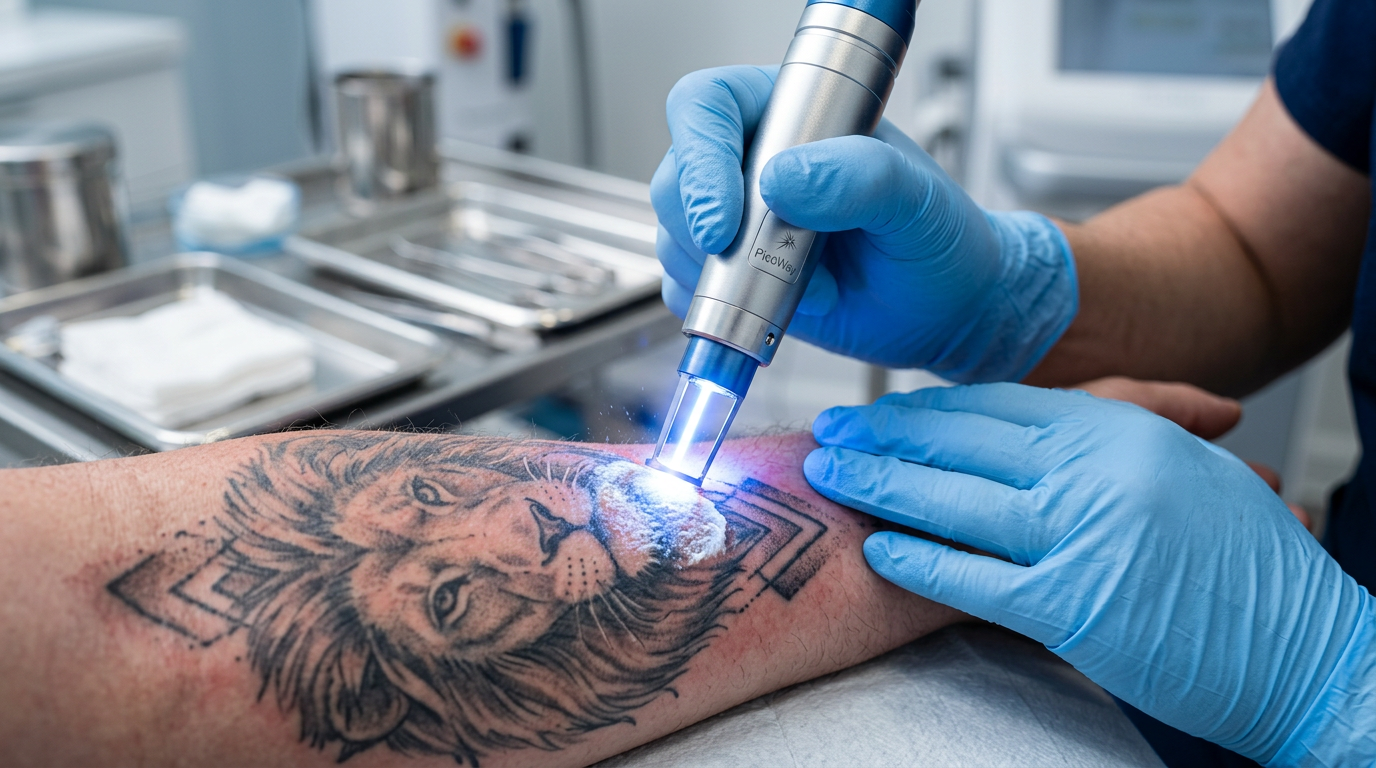
Laser tattoo removal is not a one-size-fits-all protocol. A physician adjusts parameters in real time based on the tissue response—modifying fluence, spot size, pulse rate, and wavelength as they observe how the skin reacts. They recognise the difference between an expected frosting response (the white gas bubble formation that signals successful ink fragmentation) and an adverse tissue reaction that requires immediate intervention.
Medical-grade laser platforms used in dermatology practices also offer capabilities that consumer or salon-grade systems cannot match. Multi-wavelength platforms allow doctors to switch between 532 nm, 755 nm, and 1064 nm wavelengths within a single session to address multiple ink colours, whilst advanced cooling systems protect the skin.
3. Post-Treatment and Complication Management
When complications do arise—as can happen with any clinical procedure—a physician is fully trained and legally equipped to manage them:
-
Infection: Access to proper wound care protocols and the ability to prescribe antibiotics immediately if needed.
-
Allergic reactions: Some inks (particularly reds containing mercury sulfide or cadmium) can trigger severe inflammatory reactions when fragmented by laser energy, requiring medical management.
-
Paradoxical darkening: Certain cosmetic tattoos containing titanium dioxide or iron oxide can oxidize and turn jet black with laser exposure—a doctor recognises this immediately and adjusts the treatment approach.
-
Burns and blistering: Prompt medical management prevents long-term scarring and accelerates healing.
The Risks of Non-Medical Settings
When tattoo removal is performed by undertrained operators using substandard equipment, the consequences can be severe:
Warning: The UK's Medicines and Healthcare products Regulatory Agency (MHRA) and leading dermatologists regularly warn against DIY tattoo removal creams, ointments, and home kits. There is no evidence these products work, and they often contain strong acids that cause chemical burns, severe rashes, or permanent scarring.
-
Scarring becomes significantly more common when operators cannot properly calibrate laser parameters to specific skin types.
-
Burns and deep wounds result from excessive fluence or inappropriate wavelength selection.
-
Permanent skin texture changes occur due to uncontrolled thermal damage to the dermis.
-
Incomplete removal with pigmentary damage leaves patients with the worst of both worlds: the tattoo remains visible, but the surrounding skin is permanently discoloured.
-
Single-laser limitations: Many non-medical salons use cheap, single-wavelength lasers, meaning they physically cannot address multi-coloured tattoos and may cause damage attempting to force the wrong wavelength to work.
What to Expect from Medical-Grade Treatment
A typical doctor-led tattoo removal journey follows a strict clinical pathway:
-
Consultation: A comprehensive skin and health assessment, patch testing, and an honest discussion regarding timelines and expectations.
-
Treatment sessions: Spaced 6–8 weeks apart to allow the immune system to clear the fragmented ink and the skin to fully heal between sessions.
-
Progressive fading: Each session removes layers of ink, with most patients requiring between 5–10 sessions depending on the tattoo's characteristics.
-
Aftercare guidance: Medical-grade wound care instructions, strict sun protection protocols, and ongoing clinical monitoring.
Patients should protect treated skin from sun exposure for at least three months following each session, keep all scheduled appointments (stopping early is the most common reason for unsatisfactory results), and follow prescribed aftercare protocols precisely.
The Bottom Line
Tattoo removal is a medical procedure—not a cosmetic convenience that can be safely delegated to anyone with a cheap laser and a weekend certification course. The combination of picosecond technology for superior ink fragmentation and Nd:YAG wavelengths for safe treatment across all skin types represents current best practice.
When choosing tattoo removal in the UK, protect your skin by ensuring your provider checks these boxes:
-
[ ] A GMC-registered dermatologist or doctor directly overseeing or performing the treatment.
-
[ ] CE/UKCA-marked, medical-grade laser systems featuring multiple wavelengths.
-
[ ] A thorough pre-treatment consultation that includes a full medical history review and patch test.
-
[ ] A transparent, realistic discussion regarding the expected number of sessions, potential risks, and outcomes.
Your skin is the largest organ in your body. The decision to remove a tattoo deserves the same standard of medical care you would expect for any other clinical procedure. In the hands of an experienced physician with the right technology, safe and effective tattoo fading is the expected outcome.
Would you like advice on finding registered clinics or checking medical practitioner credentials in your specific area of the UK?