How to Tell if Your Breakouts Are Actually Pityrosporum
When "acne" doesn't respond to acne treatments, the real culprit might be living on your skin right now.
You've tried the salicylic acid cleansers, the benzoyl peroxide spot treatments, and maybe even a round of antibiotics — but your breakouts won't budge. If anything, they seem to be getting worse. Before you blame your skin or your routine, consider this: what you're dealing with might not be acne at all. It might be pityrosporum folliculitis, a fungal infection that masquerades as stubborn acne and fools even the most dedicated skincare enthusiasts.
Pityrosporum folliculitis (sometimes called Malassezia folliculitis) is caused by an overgrowth of Malassezia yeast, a type of fungus that naturally lives on everyone's skin. Under certain conditions, this yeast multiplies out of control, infects hair follicles, and produces bumps that look eerily similar to traditional acne. The problem? Most people — and even some clinicians — mistake it for bacterial acne. That misdiagnosis means months or years of ineffective treatment, frustration, and damaged skin barriers.
Here's how to figure out if your breakouts are actually fungal, and what to do about it.
What Exactly Is Pityrosporum Folliculitis?
Malassezia is a genus of lipophilic (fat-loving) yeast that thrives in the oily areas of human skin — the face, chest, shoulders, and upper back. In most people, it exists harmlessly as part of the skin's natural microbiome. But when conditions shift in its favour — increased oil production, humidity, sweat, immunosuppression, or antibiotic use — the yeast proliferates, invades follicles, and triggers an inflammatory response.

The result is clusters of small, uniform, itchy bumps that can persist for months. Unlike bacterial acne, which involves Cutibacterium acnes (formerly Propionibacterium acnes) and responds to standard acne therapies, pityrosporum folliculitis requires a completely different treatment approach. That's why accurate identification matters so much.
The Key Signs It Might Be Fungal, Not Acne
1. Your Bumps Are Remarkably Uniform
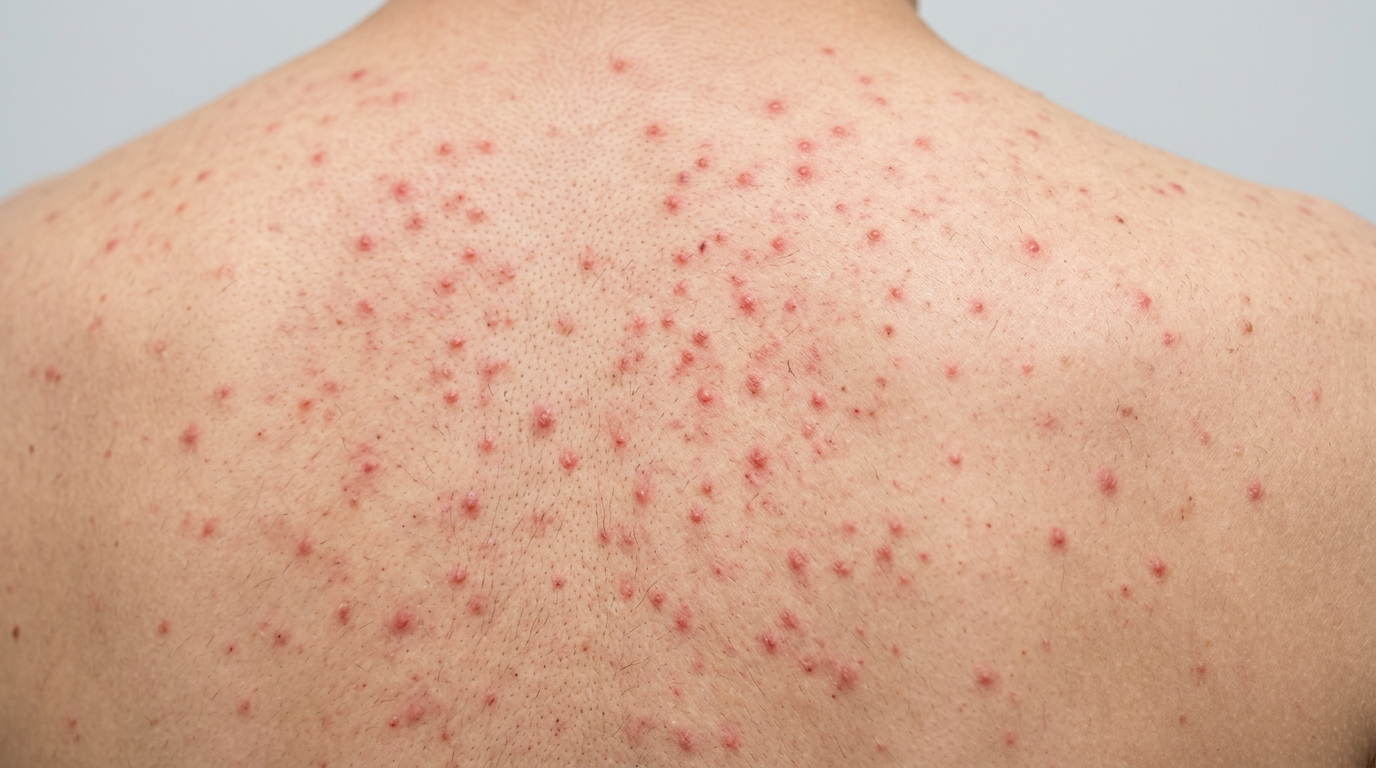
One of the biggest visual clues is uniformity. Traditional acne presents as a mix: blackheads, whiteheads, papules, pustules, cysts, and nodules of varying sizes. Pityrosporum folliculitis, on the other hand, tends to produce small (1–2 mm), dome-shaped, monomorphic papules or pustules. They look almost identical to one another, like someone stamped them onto your skin. If your breakout looks more like a rash of tiny, same-sized bumps rather than a scattered collection of different lesion types, that's a significant red flag.
2. It Itches — A Lot
Acne can be sore, tender, or painful, but it's rarely itchy. Pityrosporum folliculitis, by contrast, is frequently accompanied by a persistent, sometimes maddening itch. Many people describe it as a prickling or crawling sensation that worsens with heat and sweating. If you find yourself scratching your breakout areas — especially on the chest, back, or forehead — fungal folliculitis should be on your radar.
3. It Concentrates on the Trunk and Forehead
Location matters. While acne vulgaris commonly affects the face (especially the cheeks, jawline, and chin), pityrosporum folliculitis favours the upper back, chest, shoulders, and forehead — areas rich in sebaceous glands where the yeast thrives. Breakouts along the hairline and on the forehead that resist treatment are a classic presentation. If your face is relatively clear but your torso is covered in tiny bumps, think fungal.
4. Standard Acne Treatments Fail — or Make It Worse
This is often the clue that finally pushes people toward the right diagnosis. You've been diligent with your routine — cleansing, exfoliating, using retinols, applying topical or oral antibiotics — and nothing works. In fact, antibiotics can actively worsen pityrosporum folliculitis because they disrupt the bacterial balance on your skin, giving the yeast even more room to flourish. If your breakouts flared after a course of antibiotics, that's a strong indicator.
Similarly, heavy moisturisers, oils, and oil-based products can feed Malassezia, since the yeast metabolises certain fatty acids. If your skin seems to react badly to rich products that should theoretically help, the yeast may be the reason.
5. It Flares in Heat, Humidity, and After Sweating
Malassezia loves warm, moist environments. People with pityrosporum folliculitis often notice their breakouts worsen in summer, in tropical climates, or after workouts — especially if sweaty clothes sit against the skin for a while. If your breakouts follow a seasonal or activity-based pattern, with clear flare-ups tied to heat and perspiration, that points strongly toward a fungal cause.
6. You're Seeing No Comedones
Look closely at your bumps. Acne typically involves comedones — clogged pores that manifest as blackheads (open comedones) or small flesh-coloured bumps under the skin (closed comedones). Pityrosporum folliculitis generally does not produce comedones. If your breakout consists entirely of inflamed papules and pustules with no comedonal component, fungal involvement becomes more likely.
How to Get a Proper Diagnosis
Self-diagnosis has its limits. If the signs above resonate, the next step is seeing a dermatologist who can evaluate your skin in person. Diagnostic methods include:
-
Clinical examination: An experienced dermatologist can often distinguish fungal folliculitis from acne based on appearance and distribution alone.
-
Wood's lamp examination: Malassezia can fluoresce under ultraviolet light, though this isn't always reliable.
-
Skin scraping and microscopy: A KOH (potassium hydroxide) preparation of a skin scraping can reveal yeast cells under the microscope, providing direct evidence.
-
Skin biopsy: In ambiguous cases, a punch biopsy of a lesion can show yeast spores within the follicle, confirming the diagnosis histologically.
Don't skip the professional evaluation. Several other conditions — bacterial folliculitis, keratosis pilaris, contact dermatitis, and even eczema — can also mimic acne, and each requires its own treatment.
What to Do If It Is Pityrosporum Folliculitis
Once confirmed, the treatment shifts entirely away from traditional acne protocols and toward antifungal therapy.
Topical Antifungals
For mild to moderate cases, topical antifungal agents are the first line of defence. Common options include:
-
Ketoconazole 2% cream or shampoo: Often used as a wash on affected areas, left on for several minutes before rinsing.
-
Selenium sulfide shampoo: Applied as a body wash to reduce yeast colonisation.
-
Zinc pyrithione soap or wash: Another effective anti-yeast agent that doubles as maintenance therapy.
-
Ciclopirox cream: A broad-spectrum antifungal that targets Malassezia effectively.
Oral Antifungals
For widespread or resistant cases, oral antifungal medications like itraconazole or fluconazole may be prescribed. These are typically used as a short course (one to two weeks) and are highly effective, though they require a prescription and carry potential side effects that your dermatologist will discuss.
Skincare Adjustments
Equally important is adjusting your daily routine to stop feeding the yeast:
-
Switch to fungal-acne-safe products: Avoid ingredients that Malassezia metabolises, including certain fatty acids (oleic acid, lauric acid), esters, and oils. Online resources and community-built ingredient checkers can help you audit your products.
-
Wear breathable fabrics: Change out of sweaty clothing promptly after exercise.
-
Avoid heavy, occlusive products: Keep them away from affected areas unless they are confirmed fungal-safe.
-
Use an antifungal wash periodically: Even after clearing, continue this routine to prevent recurrence, as pityrosporum folliculitis has a high relapse rate.
The Bigger Picture: Why This Matters
Misidentified pityrosporum folliculitis isn't just a cosmetic frustration — it's a cycle that can damage your skin barrier and your confidence. Months of harsh acne treatments applied to a fungal problem strip, irritate, and weaken the skin without ever addressing the root cause. Understanding that not all breakouts are created equal is the first step toward finding a solution that actually works.
If your "acne" is uniform, itchy, concentrated on your trunk or forehead, unresponsive to standard treatments, and flares with heat and sweat — stop fighting it with acne weapons. See a dermatologist, ask about Malassezia, and explore antifungal options. The answer to your skin struggles might be simpler than you think — it's just been hiding under the wrong label.
Book your appointment here.