Article: The Ultimate Guide to REFORM Skincare HYAL Vitamin C Serum
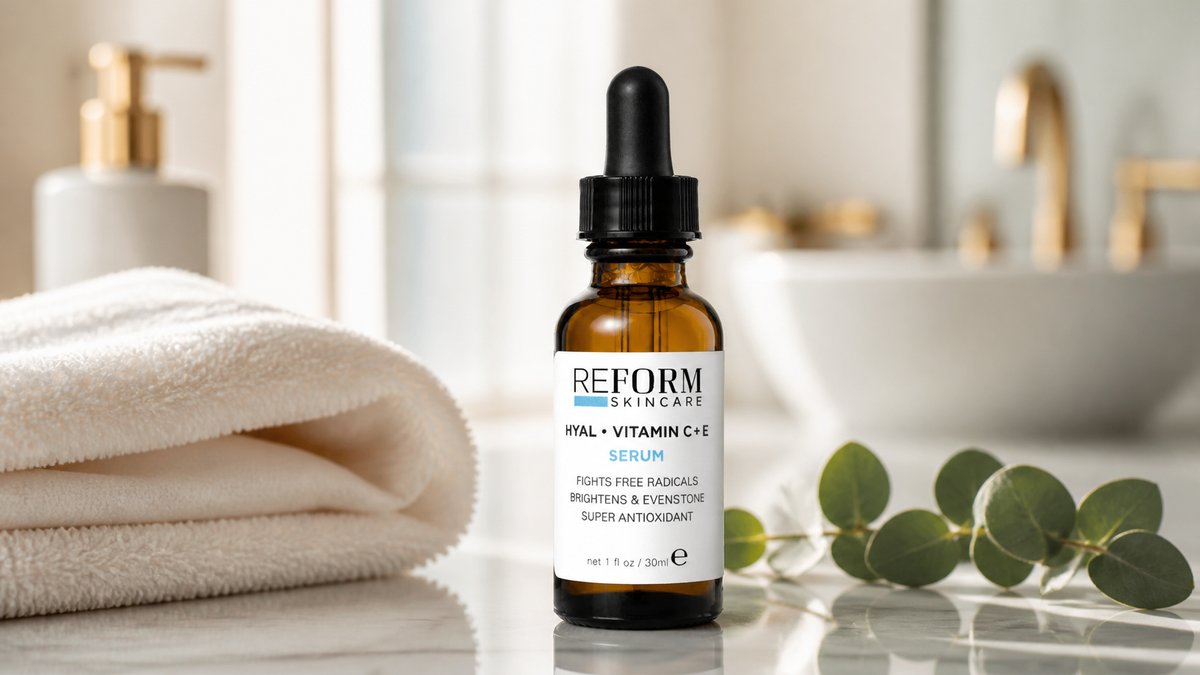
The Ultimate Guide to REFORM Skincare HYAL Vitamin C Serum
Despite being one of the few skincare ingredients backed by decades of solid research, vitamin C remains one of the most frequently misused. In most cases, the fault lies not with the formulation itself, but with its application. Introduce it at the wrong stage, pair it with incompatible active ingredients, or omit the crucial product that seals its efficacy, and even an exceptional serum will deliver only a fraction of its true potential.
REFORM Skincare's HYAL • Vitamin C + E Serum serves as a perfect case in point. Formulated with 15% L-ascorbic acid alongside vitamin E and ferulic acid, it features the golden-standard trio of antioxidant protection. These three ingredients work synergistically—stabilising and amplifying one another rather than functioning in isolation. Build the correct routine around it, and the results manifest as clarity, evenness, and that coveted luminosity. Get it wrong, and you are left with little more than an expensive bottle oxidising quietly on your bathroom shelf.
Below is the definitive guide to structuring your routine to achieve optimal results.
Step-by-Step Morning Routine
The ordering of your skincare is not arbitrary; it progresses strictly from the thinnest to the thickest textures, and from active treatments to occlusive layers. Ensure each layer is fully absorbed before applying the next to avoid simply shifting product around your face.
-
Cleanse: A gentle wash is sufficient in the morning. If you used a stronger active ingredient overnight, avoid stripping the skin barrier again at 7:00 am. REFORM's Gentle Hydrating Crème Cleanser is suitable for most skin types, removing overnight accumulations without leaving the face feeling tight. For oily or blemish-prone skin, their Salicylic Acid Foaming Cleanser is a suitable alternative, though it should serve as your sole cleanse for the day rather than part of a double-cleanse.
-
Wait for skin to dry: Wait 30 to 60 seconds. This is the step most frequently skipped, yet it fundamentally impacts serum performance.
-
Apply HYAL: Two to three drops is the recommended amount and is genuinely sufficient—this is a leave-on treatment, not a moisturiser to be applied generously. Warm the drops between your fingertips, then press and gently massage upwards and outwards across the face, neck, and décolletage. Sun damage accumulates visibly on the neck and chest, making them areas that are too often neglected. Avoid the immediate eye contour, where the skin is particularly thin and delicate.
-
Pause for absorption: Allow the product one full minute to absorb before proceeding.
-
Moisturise: While vitamin C supports the skin, it does not provide substantial hydration; a healthy moisture barrier is essential for allowing active ingredients to perform without causing irritation. For normal to dry skin types, REFORM's Intensive Moisturiser provides a richer protective layer. For oilier complexions or those preferring a lightweight base under make-up, their Everyday Moisturiser is the ideal choice. This step is non-negotiable—it ensures a 15% acid remains well tolerated day after day.
-
Apply Sunscreen: This is your absolute non-negotiable step. Vitamin C acts as a supporting layer to sun protection, never a replacement for it. A broad-spectrum SPF of at least 30—applied thoroughly and reapplied throughout the day—is what preserves your results and allows the brightening effect to become visible in the first place. REFORM's SPF 50+ Antioxidant Sunscreen is formulated to layer seamlessly over this routine without pilling, an essential quality when applying multiple products before 8:00 am.
The complete morning sequence: cleanse, dry, HYAL, moisturise, SPF. Five steps taking roughly ninety seconds once established.
Understanding the Chemistry & Proper Storage
HYAL is strictly a morning serum—a distinction rooted in chemistry rather than aesthetic preference.
As a potent antioxidant, L-ascorbic acid neutralises free radicals generated by UV radiation, pollution, and daily environmental stressors before they can break down collagen or trigger hyperpigmentation. Applying the serum in the morning ensures it is active within the skin when exposure occurs. Applying it at night means the environmental damage has already taken place.
The supporting ingredients are equally critical:
-
Vitamin E (tocopherol): A lipid-soluble antioxidant that targets different cellular compartments.
-
Ferulic Acid: Performs a dual role by stabilising vitamins C and E against degradation while providing its own antioxidant benefit.
Together, this combination extends the formula’s shelf life and enhances its duration of activity on the skin.
Essential Storage & Handling Rules
-
Store in a cool, dark place: L-ascorbic acid oxidises rapidly upon exposure to light and air. If a serum turns deep amber or brown, it has oxidised and rendered largely inert. Keep the cap tightly sealed, store away from direct sunlight, and avoid decanting the product into clear containers.
-
Apply strictly to dry skin: Applying the serum to damp skin dilutes the formulation and alters its pH, compromising the acid's ability to penetrate effectively. Wait one minute after cleansing, patting the skin completely dry.
Active Ingredients to Avoid Combining

L-ascorbic acid is acidic, and at a 15% concentration, it is highly active. Consequently, certain ingredient pairings must be avoided:
-
Exfoliating Acids: Avoid using glycolic or salicylic acids directly before vitamin C. These acids lower skin pH and remove surface cells; applying vitamin C immediately afterwards can lead to stinging, redness, and flaking. If using REFORM's Glycolic Acid Foaming Cleanser, reserve it for evening use on days when your skin barrier feels resilient.
-
Retinol: Retinol should be reserved strictly for evening application due to stability and tolerance considerations. Applying both ingredients simultaneously offers no added benefit. The most effective approach is vitamin C in the morning and retinol at night. When introducing REFORM's Retinol 1% Creme, phase it in gradually—twice weekly to begin—and reduce vitamin C application to once weekly if temporary sensitivity occurs.
-
Benzoyl Peroxide: Benzoyl peroxide oxidises vitamin C upon contact, rendering both treatments ineffective. Use these ingredients on alternate days rather than layering them.
Supporting Evening Routine
While evenings do not require vitamin C, your night-time routine should support the daytime treatments:
-
Thorough Cleansing: If SPF was worn during the day, a thorough cleanse is required to completely remove product residue rather than a simple splash of water.
-
Targeted Treatment: Apply your chosen evening treatment, such as Retinol or the Repair & Renew Gel for a gentler renewal process. Never apply both on the same evening.
-
Moisturise: Hydration remains vital overnight. If skin feels tight or reactive—a common response when introducing regular vitamin C—REFORM's Skin Barrier Repair Cream provides extra support while the skin adapts.
Mornings focus on protection and brightening; evenings focus on repair and renewal. Alternating active ingredients prevents overwhelming the skin barrier.
Realistic Timeline for Results
Skincare progress requires consistency rather than immediate expectations:
-
Weeks 1–2: Initial adaptation. You may experience a mild tingling sensation upon application, which should subside within a minute or two. The skin may appear slightly firmer or brighter as it adjusts.
-
Weeks 3–6: Early improvements in pigmentation become visible. Post-inflammatory hyperpigmentation begins to fade, and overall skin tone appears more uniform.
-
Weeks 8–12: The primary results become apparent. Collagen support and pigment regulation are gradual processes; this window reveals noticeable improvements in firmness, clarity, and overall radiance.
Consistency remains key: applying the serum five mornings a week for three months yields far better results than intensive application for a fortnight followed by discontinuation. For sensitive skin types, applying the product every other morning for the first two weeks minimizes potential irritation without compromising long-term outcomes.
Summary of Common Application Errors
-
Applying to damp skin (dilutes the formula)
-
Using excessive product (wastes serum and increases irritation risk)
-
Night-time application (misses the window of environmental exposure)
-
Omitting daily SPF (reverses antioxidant benefits)
-
Exposing the bottle to heat and light
-
Layering directly with retinol or exfoliating acids
-
Discontinuing use before the 8 to 12-week mark
The Core Takeaway
Apply HYAL • Vitamin C + E Serum every morning to clean, dry skin prior to moisturiser and broad-spectrum sunscreen. Use two to three drops across the face, neck, and chest, allowing one minute for absorption. Store the bottle sealed in a dark place, reserve retinols and exfoliating acids for evening use, and maintain consistency for eight to twelve weeks. Optimal skin radiance is the result of a well-formulated product applied correctly and protected daily with SPF.