Smoothing Acne Scars: From Medical Microneedling to Resurfacing Lasers
Acne scarring should, by rights, be a thing of the past. Modern dermatology has genuinely excellent tools for both preventing and treating it. And yet we still see it every week across our Dublin, Limerick and London clinics, because if acne is allowed to persist untreated for long enough, even mild to moderate acne can leave lasting marks. The good news is that at almost every stage — from the very first breakout to established scarring — there is something effective we can do, provided we match the right treatment to the right problem, in the right order.

“Acne scarring” is not one single thing, and our dermatologists and specialists see the full spectrum of it:
-
Acne-induced hyperpigmentation: Healed spots leave behind flat, dark or brown marks; this is particularly common and often more stubborn in skin of colour.
-
Acne-induced erythema: Lingering pink or red marks left behind after a spot has healed, especially in fairer skin.
-
True surface irregularities: Pitting, boxcar scars and rolling scars, where the skin's structure has genuinely been damaged and left uneven.
-
Hypertrophic or keloid scarring: At the more severe end, the skin overproduces tissue at the site of a healed lesion, leaving a raised, thickened mark.
Each of these has a different cause and needs a different treatment, which is why an accurate assessment before treatment matters so much.
Prevention Starts with the Right Skincare
The single most effective way to deal with acne scarring is to prevent it in the first place, and that starts with proper skincare from the very first breakout, even a mild one. Acne begins when oil blocks the pore; if that oil isn't properly removed with the right chemical exfoliants, it leads to inflammation and the proliferation of Cutibacterium acnes — the bacteria implicated in acne. The result is spots, pustules, cysts and, eventually, scarring.

This is why we recommend a proper exfoliative regime, used twice daily, for anyone with acne — not just those with more severe breakouts. Our REFORM Skincare anti-blemish kit is a simple three-step regime designed exactly for this, and it is especially useful for patients dealing with acne-induced hyperpigmentation on the face or body, as consistent, twice-daily use is what actually keeps new marks from forming in the first place.
Younger skin can be particularly sensitive, so alongside exfoliation we also focus on protecting the skin barrier:
-
REFORM Skincare Everyday Moisturiser: A genuinely high-quality, oil-free moisturiser that restores the skin barrier without clogging pores (note that it is a moisturiser rather than a sunscreen).
-
Vitamin B5 Gel: Recommended specifically to restore and support the barrier for patients whose skin becomes irritated or reactive.
-
Daily Sunscreen: Essential regardless of age, both to prevent acne scarring from forming and to improve the texture of skin that has already been affected. For this, we recommend the REFORM Mineral SPF 30 cream or the REFORM SPF mist spray, both of which are oil-free.

Why the mist is a favourite: The spray is especially popular with skin of colour, as it leaves no white cast, and with teenagers, who tend to prefer a lightweight spray they will actually use for top-ups over a cream — giving genuinely good SPF 30 protection without leaving skin or hair looking greasy.
As ever, the right formulation depends on your skin type and colour, and a free skin analysis on the REFORM Skincare website will match the right products to your skin.
When Skincare Alone Isn't Enough
If a good topical regime doesn't fully control acne vulgaris, the next step is a proper medical assessment. For many patients, a topical prescription from one of our dermatology specialists is enough, and this can be arranged through an online photo consultation for convenience. For more significant or persistent acne, we would recommend a more in-depth virtual or in-person consultation, particularly where oral medication may be needed — this route is generally reserved for more severe acne that hasn't responded to topical treatment alone.
Genetics plays a real role here too. If there is a family history of severe acne, you are already at higher risk of significant breakouts and, in turn, scarring. In this situation, we would always recommend booking a consultation early rather than waiting to see how things develop, because scarring is far easier to prevent than it is to treat after the fact.
Treating Established Scarring: Matching the Tool to the Type
Once scarring has actually formed, a good skincare regime remains important, but on its own it usually isn't enough to correct true surface irregularities. For that, our dermatologists select from a range of resurfacing and stimulating treatments based specifically on the severity and type of scarring present:
| Scarring Type / Severity | Recommended Treatment | Action / Benefits |
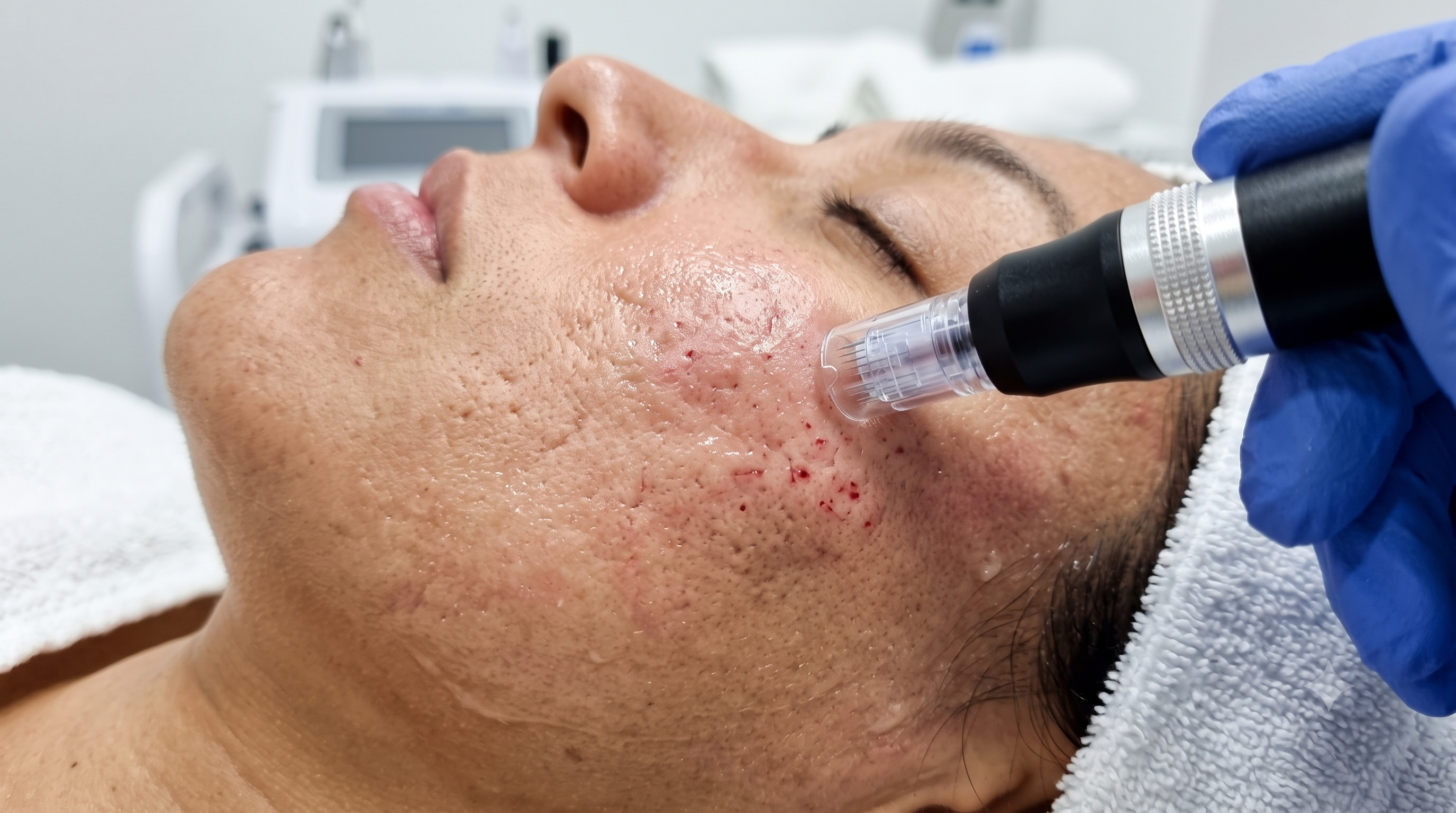
| Mild surface irregularities | Medical microneedling (sometimes with chemical peels) | Gently stimulates collagen remodelling. |
| Moderate scarring | Secret RF radiofrequency microneedling + TCA peels | Delivers a more significant remodelling effect. |
| Severe scarring | $\text{CO}_2$ laser resurfacing | An intensive resurfacing treatment reserved specifically for severe scarring given its intensity and downtime. |
| Very mild scarring / dullness | Laser Genesis | A gentle option with minimal downtime. |
| Post-inflammatory erythema | Pulsed dye laser | Targets the residual vascular redness left behind by healed acne spots. |
| Post-inflammatory hyperpigmentation(Skin of Colour) | Chemical peels combined with microneedling | Chosen carefully to treat pigmentation safely without triggering further pigment changes. |
Choosing correctly between these options, and combining them where needed, is exactly why this kind of scarring should be assessed by a dermatology specialist rather than treated with a generic “resurfacing” package.
The Golden Rule: Control the Acne Before You Treat the Scars
The single most important principle in all of this is timing. There is no point starting scar treatment while acne is still active and poorly controlled. Not everyone who has acne actually develops scarring, and treating scars before the underlying acne is addressed risks both poor results and new scarring forming during treatment.
Active acne needs to be brought under control first — or at the very least addressed alongside scar treatment — to avoid the disappointment of a treatment that simply cannot succeed while new breakouts keep occurring.
Across our clinics in Dublin, Limerick, or London, this is exactly how we approach every acne scarring consultation:
-
Control the acne itself.
-
Protect the skin with the right daily regime.
-
Treat the scarring by selecting the resurfacing or stimulating option that matches your specific type and severity.
If acne or acne scarring has been troubling you, book a consultation — in person or virtual — with one of our dermatology specialists to build a plan that actually works, in the right order.