Article: Nature's Skin Savers: How Botanical Extracts Calm, Brighten, and Restore Your Barrier
Nature's Skin Savers: How Botanical Extracts Calm, Brighten, and Restore Your Barrier
Walk into any high-street beauty store and you will see the word "botanical" printed on almost every bottle. It has become marketing shorthand for gentle, natural, and trustworthy. Yet the plants themselves are not doing the work — the specific molecules extracted from them are. A crude chamomile infusion and a standardised bisabolol fraction are not the same ingredient, even if they share a label.
Understanding that distinction separates botanical skincare that genuinely performs from botanical skincare that simply smells pleasant.
A botanical extract is a concentrated preparation drawn from a plant — leaf, root, seed, flower, or bark — using water, alcohol, glycerin, or oil as the solvent. The choice of solvent matters enormously because it determines which compounds are extracted:
-
Water pulls out polysaccharides and water-soluble flavonoids.
-
Alcohol and glycols draw out a wider range of polyphenols.
-
Oils capture fat-soluble carotenoids and tocopherols.
The second critical variable is standardisation. Raw plant material varies naturally by harvest, season, and soil quality. A serious formulator isolates and measures a specific active — such as a precise percentage of bisabolol from chamomile or a stated level of silymarin from milk thistle. Standardised extracts behave predictably on the skin; unstandardised ones do not.
1. Soothing: Calming the Reaction, Not Just the Redness
Soothing is the most familiar botanical claim, yet it remains the most poorly understood. Visible redness is merely a symptom; the underlying driver is usually an inflammatory cascade within the skin, often accompanied by a compromised barrier that lets irritants enter more easily.
Botanicals that earn their place in a routine work directly on that cascade:
-
Bisabolol: The principal active in chamomile, shown to reduce the release of inflammatory mediators.
-
Allantoin: Found in comfrey, it supports tissue comfort and is exceptionally well tolerated by reactive skin.
-
Avenanthramides: Oat-derived compounds backed by strong evidence for reducing itchiness and redness in dry, compromised skin.
-
Licorice Root: Offers dual-action benefits, providing both soothing and brightening activity through glabridin.
What these ingredients share is a clear biochemical mechanism rather than a scent. A rose-scented toner may feel lovely, but the volatile essential oils creating that fragrance can actively irritate sensitised skin. If your skin is reactive, look for fragrance-free formulas built around standardised soothing actives.
2. Brightening: Interrupting Pigment at Its Source
Brightening is where botanicals have accumulated the most credible evidence, largely because several plant compounds interfere directly with melanin production.
-
Kojic Acid: Produced by fungi during rice fermentation, it inhibits tyrosinase — the enzyme responsible for converting tyrosine into melanin.
-
Arbutin & Alpha-Arbutin: Found in bearberry and related plants (and now widely synthesised), arbutin inhibits tyrosinase more gently. Its derivative, alpha-arbutin, is considerably more stable and potent.
-
Licorice-Derived Glabridin: Inhibits tyrosinase alongside its potent soothing action.
-
Green Tea Polyphenols: Provide antioxidant support, reducing the oxidative stress that can trigger uneven pigmentation.
The Practical Caveat: Brightening botanicals work slowly. Tyrosinase inhibition alters future pigment production; it does not lift existing melanin overnight. Expect 8 to 12 weeks of consistent use before judging results. Furthermore, without daily broad-spectrum sun protection, any brightening effort is quickly undone by UV exposure. Sunscreen is not a supporting step here — it is the foundation.
3. Barrier Repair: The Least Glamorous, Most Important Work
The skin barrier is a brick-and-mortar structure of corneocytes held together by a lipid matrix of ceramides, cholesterol, and fatty acids. When that matrix thins or its composition shifts, water escapes and irritants enter, leading to dryness, stinging, flaking, and sensitivity.
Few botanicals rebuild the barrier directly, and any brand claiming a plant extract "restores ceramides" is overstating the science. Instead, botanicals support the conditions required for natural repair:
-
Soothing actives reduce the low-grade inflammation that keeps the barrier compromised.
-
Antioxidants (such as green tea, grapeseed, and rosemary polyphenols) limit oxidative damage to delicate barrier lipids.
-
Humectant-rich extracts (including aloe vera and various polysaccharide gums) improve skin hydration and pliability.
-
Oat and licorice help calm the irritation that drives scratching and further physical disruption.
The genuine rebuilding work is carried out by functional lipids — ceramides, cholesterol, squalane, and shea butter — and by leaving the skin barrier alone long enough to recover. That means pausing physical scrubs, daily exfoliating acids, and harsh cleansing while the skin heals.
Where Botanicals Fit Alongside Strong Actives
Botanical extracts are at their best as supporting players rather than headline acts. Put simply: they make aggressive routines survivable.
Consider a typical targeted protocol involving a retinoid, an exfoliating acid, and a high-percentage vitamin C. Each ingredient is effective precisely because it provokes a controlled response in the skin. However, using all three without cushioning often causes the skin barrier to give way — leading many to abandon their routine and conclude that active ingredients "do not suit them". In reality, the issue is usually the pace and the absence of support, not the actives themselves.
Well-chosen botanicals cushion this friction:
[ CLINICAL ACTIVES ]                [ BOTANICAL SUPPORT ]
  Retinoids / Acids / Vit C   +       Bisabolol / Avenanthramides
         (The Engine)                     (The Shock Absorbers)
            │                                    │
            └───────────────► ◄──────────────────┘
                              │
                    [ SUSTAINABLE RESULTS ]
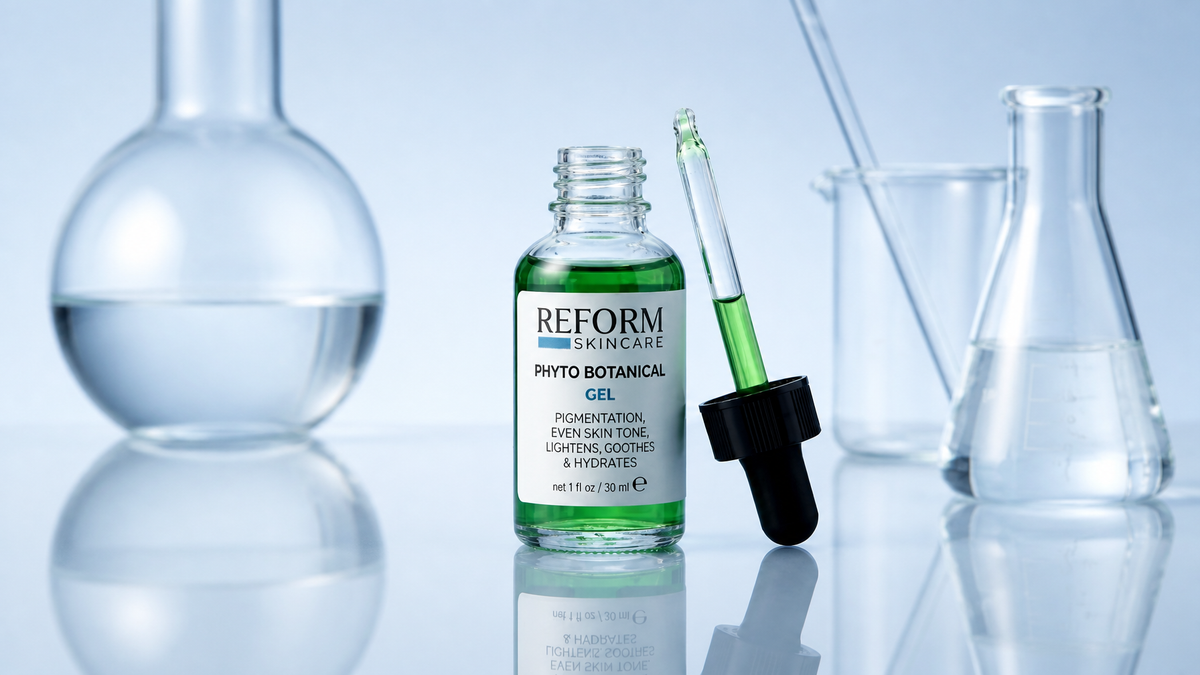
A soothing, standardised botanical complex layered alongside a retinoid can mean the difference between tolerating a treatment nightly and giving up after a fortnight. This pairing principle underpins much of modern dermatological formulation — for instance, REFORM Skincare builds its range around a combination of clinically proven actives backed by botanical support. A Phyto Botanical Gel serves as a calming, hydrating companion to assertive ingredients, while a dedicated Skin Barrier Repair Cream supports skin whose barrier has been pushed too far.

Think of botanicals as the shock absorbers of your skincare routine, while targeted clinical actives act as the engine.
How to Read a Botanical Label
Claim density is not evidence density. Use these practical filters when assessing product ingredients:
-
Check the position on the INCI list: Ingredients listed after the main preservative are present in negligible amounts. Any extract appearing below phenoxyethanol is purely decorative.
-
Look for standardisation: A label reading "chamomile extract" tells you very little. A stated percentage of bisabolol or avenanthramides proves the formulator measured a specific active.
-
Distinguish fragrance from function: Botanical fragrance is not the same as botanical function, and essential oils are among the most common triggers for contact irritation.
-
Evaluate the whole formula: Botanicals rarely work in isolation. A soothing serum lacking occlusive or lipid support will not repair a damaged skin barrier on its own.
The Honest Summary
Botanical extracts are neither miracle cures nor useless marketing fluff. A defined group — including bisabolol, allantoin, avenanthramides, licorice, kojic acid, arbutin, and green tea — possesses real, biologically plausible activity for soothing, brightening, and barrier maintenance. Much of the rest is simply fragrance accompanied by a compelling story.
Use botanicals for what they do best: calming reactive skin, managing pigment control over time, and making active-led routines sustainable. Pair them with the structural heavyweights — retinoids, acids, vitamin C, ceramides, and daily sunscreen — and allow them weeks, not days, to demonstrate results. Skin responds to long-term consistency far more reliably than to any single plant extract.