Malignant Melanoma Guide: How to Spot the Signs | UK
The skin is our largest organ, working tirelessly as a shield against the elements. Yet, because we see it every single day, it is easy to take it for granted. We notice the occasional freckle, a new sunburn that heals into a tan, or a minor blemish. But sometimes, what looks like an innocent new spot or a slightly altered mole is actually a quiet, aggressive intruder: malignant melanoma.
While melanoma accounts for only around 5% of all new skin cancer cases, it is responsible for the vast majority of skin cancer deaths. Cancer Research UK data shows that over 20,000 people are diagnosed with melanoma each year in the UK, making it the fifth most common cancer in the country, and leading to around 2,600 annual deaths.
That sounds frightening, but there is an incredibly powerful silver lining. When caught early at Stage 1, before it has a chance to spread, malignant melanoma has a five-year survival rate of nearly 100%. Education is quite literally a lifesaver. By understanding what malignant melanoma is, what causes it, and how to spot its earliest warning signs, you take control of your own health.
What is Malignant Melanoma?
To understand melanoma, we have to look beneath the very top layer of your skin, the epidermis. Nestled at the base of this layer are specialized cells called melanocytes. These cells produce melanin, the pigment responsible for the color of your skin, hair, and eyes. When your skin is exposed to ultraviolet (UV) radiation from the sun or sunbeds, your melanocytes produce more melanin to absorb the radiation and shield your skin cells from damage. This defense mechanism is what we call a tan.
However, if the UV radiation is too intense or prolonged, it mutates the DNA within these melanocytes. When the genetic code is damaged, the cells lose their natural instructions to grow and die off in a controlled cycle. Instead, they begin multiplying rapidly and abnormally, forming a malignant (cancerous) tumour.
Because these mutated cells originate from pigment-producing cells, the resulting cancer usually appears as a dark, irregular spot. However, unlike more common, slower-growing skin cancers like basal cell carcinoma or squamous cell carcinoma, melanoma is highly aggressive. If it isn't treated early, it can break away from its origin point, enter the bloodstream or lymphatic system, and spread (metastasise) to vital organs like the lungs, liver, and brain.
The Hidden Diversity: Types of Melanoma
Not all melanomas look or behave the same way. Knowing the different types can help you understand why checking your entire body is so essential.
-
Superficial Spreading Melanoma: This is the most common form, making up about 70% of all cases. It tends to grow along the top layer of the skin for a while before penetrating deeper. It usually looks like a flat or slightly raised discoloured patch with irregular borders.
-
Nodular Melanoma: This is a particularly aggressive variant. Instead of spreading across the surface, it grows downward into the skin quickly. It often appears as a firm, raised bump (or nodule) and can be dark blue, black, pink, or red.
-
Lentigo Maligna Melanoma: Most common in older adults, this type develops on chronically sun-exposed areas like the face, ears, and arms. It begins as a flat, slow-growing freckle-like patch that gradually darkens and changes shape.
-
Acral Lentiginous Melanoma: This is a rare form but uniquely dangerous because it appears in areas that rarely see the sun. It develops on the palms of the hands, soles of the feet, or underneath fingernails and toenails (often appearing as a dark streak). This is the most common type of melanoma found in people of colour.
How to Spot It: The ABCDE Guide

The most vital tool you have for catching melanoma is a simple self-examination. Dermatologists universally use the ABCDE acronym to help people identify the warning signs of a dangerous mole. When you perform your monthly head-to-toe skin check, look for these specific traits:
A is for Asymmetry
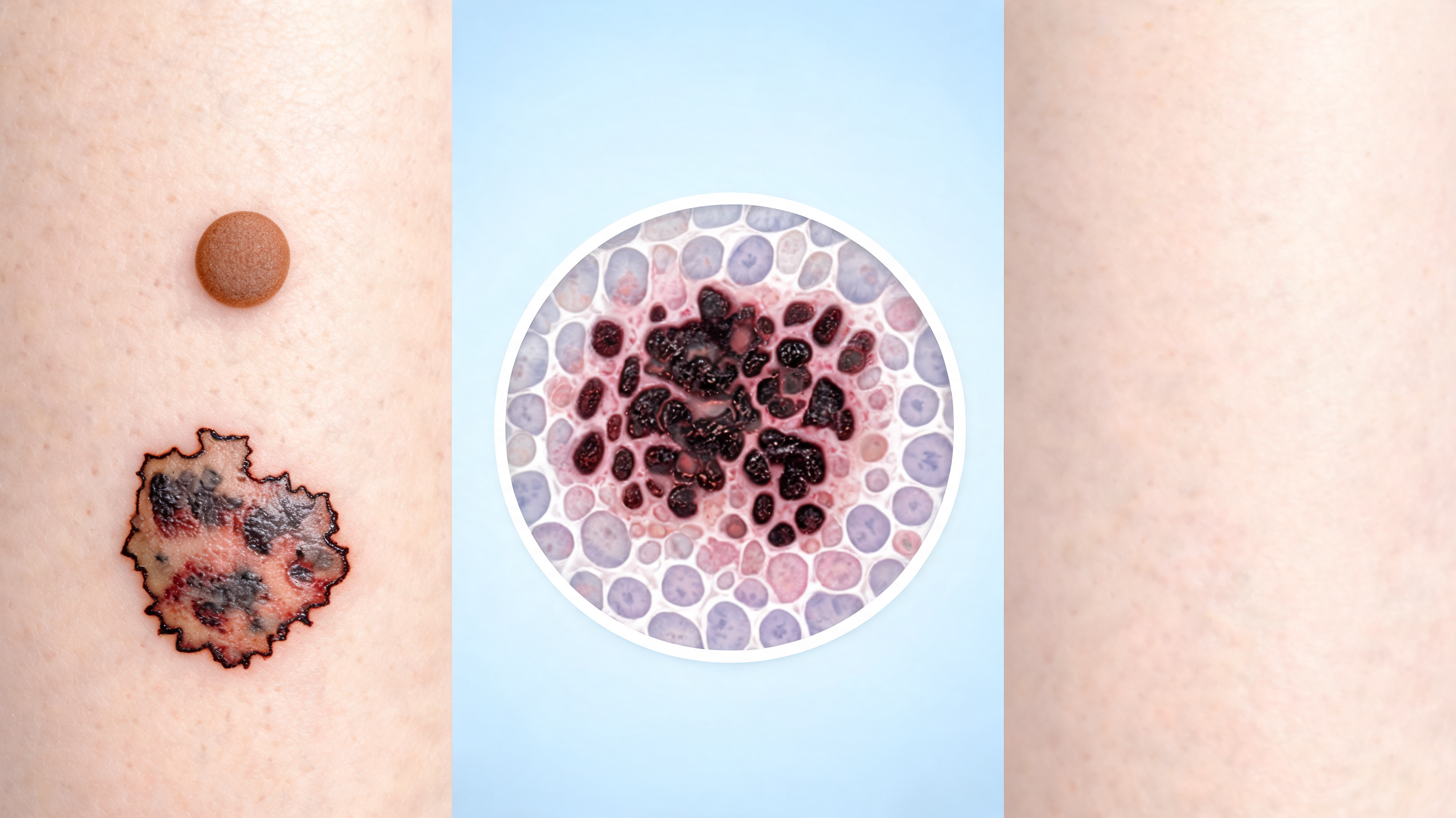
If you draw an imaginary line right down the middle of a healthy, benign mole, the two halves will look like mirror images of each other. They are symmetrical. A melanoma, however, grows unevenly. One half of the spot will look completely different in shape, thickness, or structure than the other half.
B is for Border Irregularity
Take a close look at the edges of the spot. A normal mole has clean, smooth, and well-defined borders. The borders of a melanoma are often notched, scalloped, jagged, blurred, or ragged. The pigment may look like it is bleeding or leaking into the surrounding skin.
C is for Colour Variation
A safe mole is typically uniform in colour—usually one solid shade of tan or brown. Malignant melanomas are masters of disguise, displaying a patchwork of colours. Within a single spot, you might see varying shades of brown and black mixed with patches of red, white, pink, or even blue.
D is for Diameter
As a general rule of thumb, benign moles stay relatively small. If a spot is larger than 6 millimetres across—roughly the size of the end of a standard pencil—it deserves a professional look. That said, do not disregard a spot just because it is tiny; many melanomas are caught when they are much smaller.
E is for Evolving
This is arguably the most critical factor of all. Healthy moles look the same year after year. If a mole is changing in size, shape, colour, or height, it is evolving. This also includes the sudden onset of new symptoms, such as a spot that starts itching, tenderness, scaling, crusting, or bleeding spontaneously.
The "Ugly Duckling" Sign
If you have dozens of moles, running through the ABCDE checklist for every single one can feel overwhelming. That is where the Ugly Duckling sign comes in handy.
The concept is simple: most benign moles on an individual's body tend to resemble one another. They might all be small and dark, or large and light brown. They form a family. A melanoma is the "ugly duckling" that doesn't match the rest of the family. It might be much larger, a completely different colour, or the only raised bump on an otherwise flat field of freckles. If a spot simply looks odd or stands out from its neighbours, trust your gut and have a healthcare professional examine it.
Am I at Risk? Understanding the Factors
While anyone can develop skin cancer, certain factors can significantly stack the deck against you. Understanding your risk profile can help you determine how vigilant you need to be.
| Risk Category | High-Risk Indicators | Why It Matters |
| Sun Exposure | History of blistering sunburns, frequent sunbed use | Around 86% of UK melanomas are directly linked to cell damage from ultraviolet (UV) radiation. |
| Physical Traits | Fair skin, light eyes (blue/green), blonde or red hair | Lighter skin contains less protective melanin, making it more vulnerable to DNA-damaging UV rays. |
| Mole Count | Having more than 50 standard moles or several atypical moles | A higher volume of moles simply increases the biological real estate where mutations can occur. |
| Genetics | Family history of melanoma | Certain inherited gene mutations can heavily impair your body's natural ability to repair DNA damage. |
Prevention: Your Daily Shield
Knowing the signs is your safety net, but prevention is your primary armour. Guarding your skin against malignant mutations doesn't require avoiding the outdoors entirely—it just requires building healthy, daily habits.
-
Embrace Sunscreen Every Day: Apply a broad-spectrum sunscreen with an SPF of 30 or higher every single day when the UV index is 3 or above, even when it is cloudy. Broad-spectrum means it protects against both UVA rays (which age the skin and cause long-term damage, rated by a star system in the UK) and UVB rays (which cause sunburns). Reapply every two hours if you are swimming or sweating.
-
Ditch the Sunbeds: There is no such thing as a "safe" UV tan. Using an indoor sunbed before the age of 35 can increase your lifetime risk of melanoma by an astonishing 75%. If you love a sun-kissed look, opt for fake tan lotions or spray tans.
-
Seek Shade During Peak Hours: The sun’s UV rays are at their absolute strongest between 11:00 AM and 3:00 PM in the UK. Whenever possible, plan outdoor activities in the early morning or late afternoon, or stay under umbrellas and trees.
-
Wear Protective Clothing: Fabric is a highly effective physical barrier. Wear tightly woven clothing, long sleeves, a wide-brimmed hat that shields your face and ears, and UV-blocking sunglasses to protect the delicate skin around your eyes.
What to Do If You See a Suspicious Sign
If you discover a spot on your body that triggers an ABCDE red flag or looks like an ugly duckling, do not panic, but do act quickly.
Schedule an appointment with your GP. If they share your concern, they will refer you to a consultant dermatologist via the NHS urgent suspected cancer pathway (often called the two-week wait).
The specialist will look at the spot with a specialized magnifying tool called a dermatoscope. If necessary, they will perform a quick skin biopsy. This involves numbing the area with a local anaesthetic and taking a small sample or removing the spot entirely to look at under a microscope.
If it does turn out to be melanoma, your doctor will discuss treatment options. For early-stage melanomas, a simple surgical excision—cutting out the tumour and a small safety margin of healthy skin around it—is often the only treatment required. For advanced stages that have spread, modern medicine has made massive leaps forward. Treatments like immunotherapy (which trains your own immune system to fight the cancer) and targeted therapies have drastically improved survival rates over the last decade.
Your skin protects you every second of the day. Take ten minutes once a month to protect it back by checking your skin. If you see something, say something to a doctor. It might just save your life.