Article: Daily Defense: Why You Need SPF 30 Mineral Sunscreen Year-Round
Daily Defense: Why You Need SPF 30 Mineral Sunscreen Year-Round
Sunscreen is often treated as a seasonal product: essential for beach holidays and bright summer days, but easy to forget once the temperature drops. Yet ultraviolet radiation does not disappear in autumn or winter. Your skin is exposed to it throughout the year, whether you are walking to work, driving, sitting beside a window or spending an overcast afternoon outdoors.
Making SPF 30 mineral sunscreen part of your daily routine is one of the simplest and most effective ways to protect your skin from premature ageing, pigmentation and sun damage.
UV exposure is not just a summer concern
The sun emits two main types of ultraviolet radiation that affect the skin: UVA and UVB.
UVB rays are closely associated with sunburn and tend to be strongest during warmer months. UVA rays, however, remain present throughout the year. They can pass through cloud cover and glass, reaching the deeper layers of the skin even when the weather feels cool or grey.
This cumulative exposure matters. A short walk, a commute and time spent near a bright window may not cause visible redness, but repeated exposure can gradually contribute to:
-
Fine lines and wrinkles
-
Uneven skin tone
-
Dark spots and pigmentation
-
Loss of firmness
-
Changes in skin texture
-
An increased risk of skin cancer
Daily sunscreen is therefore not simply about avoiding sunburn. It is about limiting the long-term effects of UV radiation before they become visible.
Why SPF 30 is a strong everyday choice
The sun protection factor, or SPF, indicates how well a sunscreen protects against UVB radiation when used correctly. SPF 30 filters approximately 97% of UVB rays, making it a reliable level of protection for everyday use.
No sunscreen blocks all UV radiation, and a higher number does not make application foolproof. The amount applied, the areas covered and the frequency of reapplication all have a significant effect on protection.
Look for an SPF 30 sunscreen that also offers broad-spectrum protection, which means it is designed to defend against both UVA and UVB rays. For daily life, the best sunscreen is ultimately one that provides suitable protection and feels comfortable enough to use consistently.
What makes mineral sunscreen different?
Mineral sunscreens use UV filters such as zinc oxide and titanium dioxide. These ingredients form a protective layer on the skin and help shield it from ultraviolet radiation.
They are often chosen by people with sensitive, reactive or blemish-prone skin because mineral formulations can be well tolerated. They may also suit those who prefer a straightforward sunscreen step within an active skincare routine.

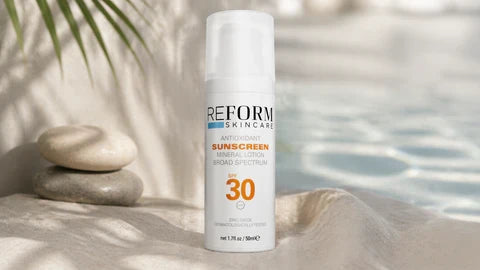
A modern mineral sunscreen should spread evenly, sit comfortably beneath make-up and avoid leaving the skin feeling excessively heavy. REFORM Skincare SPF 30 Mineral Sunscreen can be incorporated as the final step of a morning routine for everyday broad-spectrum protection.
Sunscreen supports your skincare results
A carefully chosen skincare routine can help improve hydration, texture and tone, but leaving the skin unprotected may undermine that progress.
UV exposure can worsen pigmentation and accelerate the breakdown of collagen and elastin. It can also make skin more vulnerable when using active ingredients intended to renew or exfoliate the surface. This is particularly relevant for routines containing retinol or exfoliating acids.
Products such as REFORM Skincare Retinol 1% Crème or its glycolic and salicylic acid cleansers should be used according to their directions, with diligent daytime sun protection. Sunscreen does not replace careful use of active ingredients, but it is an essential partner to them.
Protection matters in every season
-
Spring: As daylight hours increase, UV exposure can become more significant before the weather feels particularly warm. This is an easy time to underestimate the sun, especially during walks, outdoor lunches or gardening.
-
Summer: Longer days and more time outdoors make regular application and reapplication especially important. Sunscreen should be combined with shade, protective clothing, sunglasses and a hat.
-
Autumn: Cooler air does not mean UV radiation has vanished. Continuing to apply sunscreen every morning helps maintain a consistent habit and supports efforts to manage uneven tone or pigmentation.
-
Winter: UVA rays remain present during winter and can penetrate windows. Snow may also reflect UV radiation, increasing exposure during skiing and other winter activities. Daily protection is still necessary, particularly for the face, ears, neck and hands.
How to apply mineral sunscreen correctly
Even an excellent formula cannot provide its labelled protection if too little is applied. Use a generous, even layer over all exposed skin.
For the face and neck, many people find the two-finger method useful: apply two lines of sunscreen along the length of the index and middle fingers. The exact amount required can vary with the formula and the area covered, so follow the product instructions as your primary guide.
Apply sunscreen:
-
After skincare, as the final step of your morning routine.
-
Before make-up, allowing it time to settle first.
-
To commonly missed areas, including the ears, hairline, neck and around the eyes where suitable.
-
Before sun exposure, following the timing stated on the label.
-
Repeatedly when necessary, especially after swimming, sweating or towel-drying, and during prolonged outdoor exposure.
Do not rely solely on SPF in foundation or moisturiser unless you apply enough to achieve the stated protection. In practice, most people use too little make-up for this.
A simple morning routine
Sun protection does not require a complicated regimen. A practical routine might include:
-
A gentle cleanser
-
A hydrating or antioxidant serum
-
Moisturiser, if needed
-
SPF 30 mineral sunscreen
For dry or compromised skin, a moisturiser can help create a comfortable base beneath sunscreen. Depending on your skin's needs, REFORM Skincare Everyday Moisturiser or Skin Barrier Repair Cream may be used before SPF. Avoid adding products simply for the sake of a longer routine; consistency and compatibility are more important than the number of steps.
Common sunscreen mistakes
-
Only wearing SPF when it is sunny: Cloud cover reduces visible light and warmth, but it does not eliminate UV exposure.
-
Applying too little: A thin, uneven layer may provide significantly less protection than the number shown on the packaging.
-
Missing exposed areas: The ears, neck, chest, hairline and backs of the hands are frequently overlooked.
-
Treating morning application as all-day protection: Reapplication becomes important during extended outdoor activity or when sunscreen has been disturbed.
-
Using sunscreen as permission to stay in the sun longer: SPF is one part of sun safety, not a licence for unlimited exposure.
-
Keeping the same bottle indefinitely: Check the expiry date and the period-after-opening symbol. Replace sunscreen if its texture, colour or smell changes.
Consistency is the real anti-ageing strategy
No skincare product can completely prevent ageing, nor should healthy skin be expected to remain unchanged. However, daily broad-spectrum sunscreen can help reduce preventable UV-related damage and support a more even, resilient-looking complexion over time.
The most effective routine is not necessarily the most elaborate. It is the one you can repeat every morning, regardless of the forecast. Cleanse, moisturise if needed, apply SPF 30 mineral sunscreen, and reapply when your exposure demands it.
Year-round sun protection is less about reacting to bright weather and more about building a dependable daily defence. Your skin encounters UV radiation in every season; your sunscreen habit should be just as consistent.