
Basal Cell Carcinoma: Diagnosis, Treatment and Prevention at Adare Dermatology Clinics
Basal cell carcinoma (BCC) is the most common form of skin cancer, and it's one we see regularly across our clinics in Dublin, Limerick, and London. While BCC is often described as “low risk” because it rarely spreads to distant parts of the body, that label can be misleading. Left untreated, BCC invades locally, destroying surrounding skin, cartilage, and even bone if it reaches the face. And having one BCC significantly raises your risk of developing further skin cancers — including melanoma — down the line. This is why we take a structured, lifelong approach to detection, treatment, and prevention for every patient at Adare Dermatology Clinics (ADC).
How We Diagnose Basal Cell Carcinoma
Full-Body Mole Screening and Dermoscopy
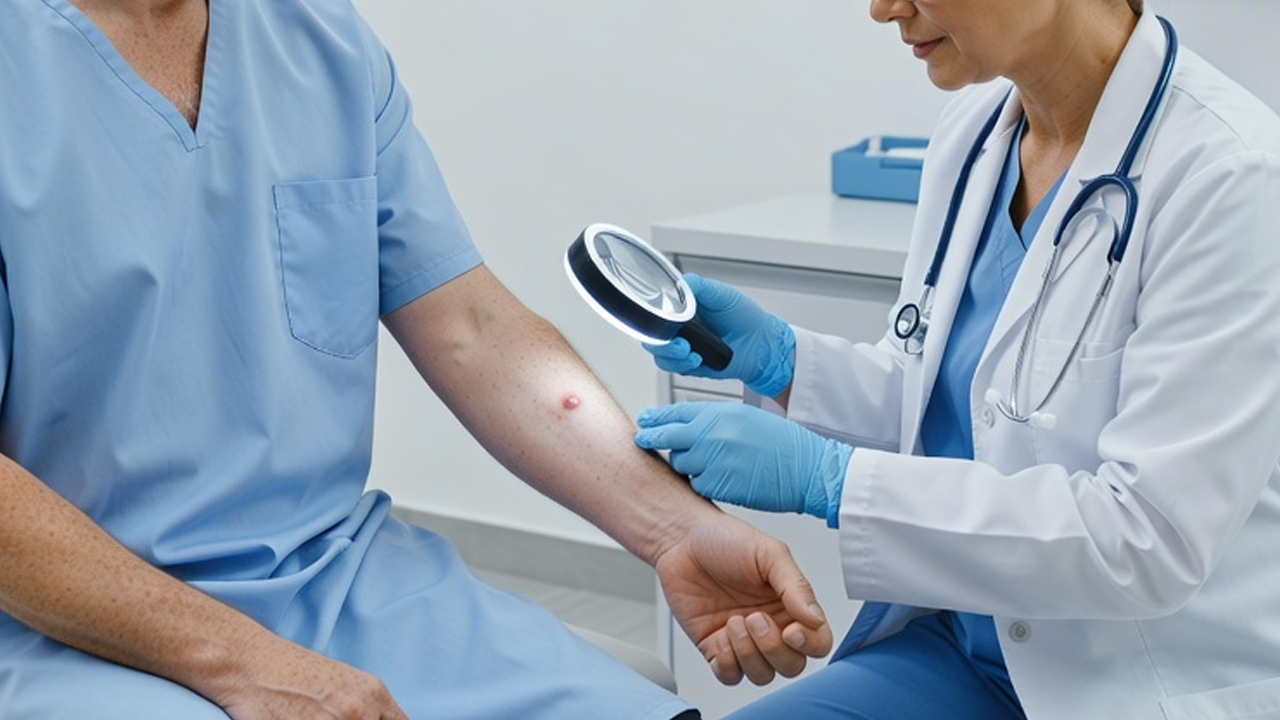
Early detection starts with a thorough full-body skin examination. At ADC, we use dermoscopy — a handheld magnification device that lets our clinicians examine the structures within a lesion that aren't visible to the naked eye, such as abnormal blood vessel patterns, pigment networks, and ulceration. This allows us to distinguish suspicious lesions from harmless ones with far greater accuracy than a visual check alone.

For patients with a personal or family history of skin cancer, or significant sun exposure over their lifetime, we recommend a comprehensive mole screening at least once a year, supported by total-body imaging where appropriate. This creates a baseline record of every mole and mark on your skin, so that any new or changing lesion can be picked up early at a follow-up visit.
Biopsy and Confirmation
If dermoscopy identifies a lesion that looks suspicious for BCC, the next step is tissue diagnosis. Depending on the size, location, and appearance of the lesion, this may be:
-
Diagnostic biopsy — a small sample of the lesion is removed under local anaesthetic and sent for histopathology to confirm the diagnosis and subtype before planning definitive treatment.
-
Excisional biopsy — for smaller, well-defined lesions, we may remove the whole lesion with a margin of healthy tissue in one step, which serves as both diagnosis and treatment.
The histology report tells us not just that it's a BCC, but which subtype we're dealing with, which is central to deciding on the right treatment.
Treatment: Matched to BCC Subtype and Patient Needs
BCC isn't a single, uniform disease — its subtype significantly influences how we treat it.
-
Superficial BCC tends to grow slowly along the surface of the skin and often responds well to topical treatments or minimally invasive procedures.
-
Nodular BCC is the most common subtype, presenting as a firm, often pearly nodule. It usually needs surgical removal.
-
Morphoeic (morpheaform) BCC is more infiltrative, with poorly defined edges that extend further under the skin than they appear on the surface — these require more precise surgical margins.
At ADC, our treatment options include:
-
Topical Efudix (5-fluorouracil) — a chemotherapy cream, primarily used for superficial BCCs, particularly in patients who prefer to avoid surgery or where the lesion is in a location where scarring is a major concern.
-
Cryotherapy — freezing the lesion with liquid nitrogen, suitable for selected superficial lesions.
-
Standard surgical excision — the lesion is removed with a clear margin of healthy tissue and the wound closed; this remains the mainstay for nodular BCC.
-
Mohs micrographic surgery — a specialised technique where the surgeon examines tissue layer by layer under the microscope in real time, removing only what's cancerous while sparing as much healthy tissue as possible. This is our preferred approach for morphoeic BCC and for lesions in cosmetically or functionally sensitive areas such as the nose, eyelids, and ears, where preserving tissue matters most.
-
Radiotherapy referral — for patients who aren't suitable for surgery, or who prefer a non-surgical route, we can refer for radiotherapy as a definitive treatment.
Which option is right for you depends on the BCC subtype, its location, your general health, and your own preferences. We talk through all suitable options at your consultation so you can make an informed choice.
Why Prevention Matters as Much as Treatment
Because a BCC diagnosis substantially increases your future risk of skin cancer, prevention isn't a one-off effort — it needs to become as automatic as brushing your teeth. That means daily photoprotection, not just protection on obviously sunny days.
UVB and UVA: Two Different Threats
Most people know UVB rays cause sunburn and are strongly linked to skin cancer. Fewer people realise that UVA is just as important. UVA penetrates more deeply into the skin, contributes to premature ageing, and — critically — passes through window glass. This means you can be accumulating UVA damage while driving, sitting near a window at your desk, or working near a window at home, all year round, even in winter and on overcast days. Broad-spectrum protection against both UVB and UVA is essential, every single day.
REFORM Skincare: Daily Protection Built for Real Life
Our in-house REFORM Skincare range was developed to make daily, broad-spectrum sun protection genuinely easy to stick to:

-
REFORM SPF 50+ broad-spectrum sunscreen for the face and neck, formulated to sit comfortably under makeup and daily wear.
-
REFORM Vitamin C 20% serum, used alongside SPF to help protect against oxidative damage from UV exposure and support skin repair.
-
REFORM retinol, incorporated into an evening routine to support skin renewal and long-term skin health.
-
REFORM SPF 30 and SPF 50 mist sprays — designed for areas that are easy to miss or awkward to reach, such as the ears and the scalp. These are especially important for men with thinning hair or male-pattern baldness, but we're increasingly recommending them to women too, as female pattern hair thinning becomes more visible with age. The mist format also makes reapplication throughout the day simple — over makeup, over hair, without disrupting either.
Beyond Sunscreen: Physical Photoprotection
Sunscreen alone isn't enough. We advise all patients, particularly those with a personal history of skin cancer, to build physical protection into their daily habits:
-
Wide-brimmed hats to shield the face, ears, and scalp — areas that are both high-risk for BCC and easy to under-treat with sunscreen alone.
-
Long sleeves and UPF-rated clothing, particularly during prolonged outdoor exposure.
-
Sunglasses with UV protection, to protect the delicate periocular skin and the eyes themselves.
Ongoing Surveillance
For anyone who has had a BCC, we recommend:
-
Full-body mole screening at least annually, using dermoscopy to catch new or changing lesions early.
-
Regular self-checks between clinic visits — get to know your own skin, and flag anything new, growing, bleeding, or non-healing to your clinician promptly.
-
Daily photoprotection as routine, not an occasional effort.
Book Your Skin Check
BCC is highly treatable, particularly when caught early, and we tailor every treatment plan to the specific subtype and to what matters most to you — whether that's minimising scarring, avoiding surgery, or ensuring the most thorough tissue clearance possible. Combined with daily, broad-spectrum photoprotection using the REFORM Skincare range and consistent physical protection, most future BCCs are genuinely preventable.
To book a full-body mole screening or discuss a lesion that's concerning you, contact your nearest Adare Dermatology Clinic in Dublin, Limerick, or London.
%20is%20the%20most%20common%20form%20of%20skin%20cancer,%20and%20it's%20one%20we%20see%20regularly%20across%20our%20clinics%20in%20Dublin,%20Limerick,%20and%20London.%20While%20BCC%20is%20often%20described%20as%20%E2%80%9Clow%20risk%E2%80%9D%20becau...)